Shoppable Funnels
A/B/N Testing Landing Pages for ChatGPT vs Organic Traffic
How enterprise commerce brands structure segmented experimentation across conversational AI referrals and search engines.

Sakshi Gupta






Key Takeaways
Run one A/B/N framework with two parallel segments (ChatGPT referral vs organic search) so you can detect interaction effects without mixing intent.
Hold the URL and core content steady through the test to limit Google Search exposure, and roll out safely rather than spinning up rival indexable URLs.
Design ChatGPT-referred variants to match the conversation vocabulary and answer pricing and fit within the first screen to reduce bounce and speed decisioning.
Measure outcomes beyond conversion rate by segment, including revenue per session, assisted conversions, and downstream quality signals rather than clicks alone.
Operationalize winners by routing both segments from one brand-owned URL and shipping machine-legible parity versions for agents without changing facts.
To structure an A/B/N test for landing pages receiving high referral traffic from ChatGPT versus organic search, execute a single experiment using shared variants while evaluating performance across pre-defined traffic segments. This segmented factorial approach isolates differing user intent, protects organic search authority on your canonical URL, and allows tailored first-screen messaging for conversational visitors.
Why ChatGPT Referral Traffic Needs a Dedicated Test Design
AI referrals and organic search carry fundamentally different purchase intent, requiring segmented analysis to prevent false winners. Commerce now operates across two distinct moments: moment one is getting recommended by conversational discovery engines, and moment two is converting that recommendation. While landing page experimentation resides in moment two, it must directly reflect the prompt context established in moment one. Brands track recommendation share and discovery patterns across ChatGPT, Perplexity, and Google AI Overviews using AI Visibility to uncover upstream intent before deploying tests.
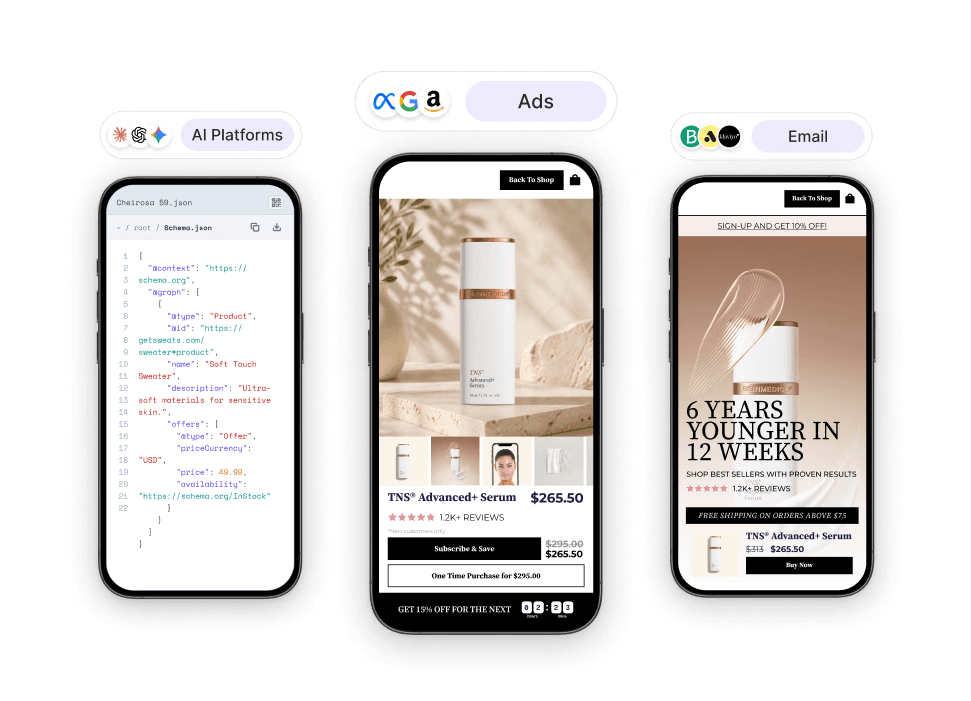
Semrush puts AI search visitors at roughly 4.4 times as valuable as the average organic visitor, and about 3 times as likely to convert, so this traffic arrives with real commercial intent. Search visitors typically scan multiple options from a general query, whereas ChatGPT referrals arrive with precise conversational context, pre-validated criteria, and expectations of instant confirmation. Mixing these audiences into a single unstructured test skews data and yields suboptimal winners for both groups. Brands resolve this by leveraging Funnels (across agents, ads and organic) to dynamically serve origin-tailored journeys from a single canonical URL hosted directly on the brand domain.
Routing Origin-Specific Journeys from One Brand URL
Modern experimentation requires serving distinct experiences without generating URL sprawl or fragmenting domain equity. When funnels and content live on your own domain, citations and search authority accrue directly to your brand rather than a third-party domain. By operationalizing Funnels, catalog teams can route conversational AI traffic to conversation-matched landing journeys while simultaneously serving standard catalog templates to organic searchers.
How to Structure the Segmented Factorial A/B/N Experiment
Follow a disciplined, step-by-step methodology to structure landing page tests across distinct referral origins:
Define hypothesis and primary metric: Formulate specific hypotheses regarding conversation continuity. Set revenue per session or primary conversion rate as the primary metric, with average order value (AOV) and return rate as secondary guardrails.
Configure origin segments in analytics: Isolate traffic sources using clean source and medium parameters (such as chatgpt.com / referral and google / organic). Maintain a centralized referral list paired with AI Visibility to capture emergent platforms and unseen referral patterns.
Select the test design: Choose between standard A/B, A/B/N, or sequential rollouts based on traffic volume per segment to ensure statistical power without prolonging runtime.
Randomize and bucket visitors: Ensure visitor bucketing occurs deterministically at the edge or client level while preserving the visitor segment assignment across their entire browsing session.
Establish guardrails and stop conditions: Comply strictly with Google Search Central A/B testing guidance by keeping canonical URLs stable, preventing unwanted indexing of temporary parameter variants, and avoiding radical layout shifts that could be flagged as deceptive.
Design Choice | When to Use for ChatGPT vs Organic | Pros & Cons | SEO Risk | Recommended Nudge Pillar |
|---|---|---|---|---|
Segmented A/B Test | Low to moderate AI traffic volume; testing one targeted hypothesis (e.g., above-the-fold pricing). | Pros: Fast time-to-significance, simple attribution. Cons: Limits the number of simultaneous creative variations. | Lowest: Keeps URL and main content stable for crawlers. | Funnels |
Segmented A/B/N Test | High traffic volumes; comparing multiple narrative frameworks against standard search layouts. | Pros: Tests multiple value propositions simultaneously. Cons: Requires larger sample sizes to prevent sample ratio mismatch. | Low: Safe when executed on a single canonical URL. | Funnels |
Sequential Rollout | Spiky or emerging AI referral streams where immediate testing is needed on a bounded prompt cluster. | Pros: Rapid iteration on high-intent prompt cohorts. Cons: Sensitive to seasonality and external algorithmic shifts. | Medium: Requires strict canonical tagging. | AI Visibility |
Catalog Level Parity Deployment | Rolling out winning structured product attributes and policy data across SKUs for buyer agents. | Pros: Scales conversion and transactional clarity globally. Cons: Requires deep PIM and feed synchronization. | None: Enforces parity guarantee across search engines and agents. | Catalog Enrichment |
What to Test First on ChatGPT-Referred Landing Pages
To close the conversion gap on conversational traffic, prioritize above-the-fold message relevance, transparent commercial terms, and cognitive friction reduction before modifying global site navigation. When visitors arrive from an AI recommendation, they expect direct continuity with the conversational prompt that sent them.
First, test vocabulary matching by echoing the problem framing and specific criteria evaluated in the chatbot conversation. Replacing generic brand slogans with explicit capability statements directly addresses the user intent. Second, test first-screen decisioning modules that immediately expose clear pricing, model fit matrices, return terms, and shipping constraints. Visitors referred by conversational engines bounce when critical constraints discussed in their chat are obscured behind multiple clicks.
Third, streamline checkout and lead capture workflows. Imagescape cut a contact form from 11 fields to 4 and saw conversion rise 120%, a useful signal on form friction even though it was a lead form rather than a checkout. Test minimal-step checkouts and frictionless verification on your own traffic before assuming the same size of win. Deploying these journey-level adjustments through Funnels ensures tailored experiences remain entirely on the brand domain.
Measuring Success by Origin Without Compromising Attribution or Search
Accurate experimentation requires segmenting conversational referrals from organic search across your core analytics stack while protecting canonical indexation. Define ChatGPT referrals in GA4 using source and medium values such as chatgpt.com / referral, while isolating standard organic traffic via google / organic. Because conversational discovery platforms evolve continually, brand teams pair standard web analytics with AI Visibility to quantify recommendation share and detect visits driven by conversational prompts that bypass standard referrer strings.
Track a robust metric hierarchy: designate revenue per visitor and checkout conversion rate as primary metrics, while monitoring AOV, assisted conversion paths, and return rate proxies as secondary health signals. Guardrail metrics must track page speed, bounce rates, and organic index coverage throughout the test duration.
Search-safe experimentation requires serving content from a stable canonical URL rather than generating fragmented, indexable sub-pages. When delivering machine-readable specifications to automated tools, brands deploy Catalog Enrichment backed by the parity guarantee. This ensures that the version of the page built for agents remains provably fact-identical to the consumer experience, keeping product data accurate while search engine crawlers continue evaluating the authentic site.
Operationalizing Winners Across Prompts and Large Product Catalogs
Scaling experimentation wins requires transitioning validated landing experiences into permanent catalog templates across high-value queries. Identify winnable intent by isolating bounded prompt clusters where your product directly solves the shopper's goal and your brand achieves consistent citation frequency. Once a test demonstrates statistically significant lift in revenue per session, deploy the winning layout as the default journey for that origin.
Operationalizing changes requires concrete proof moves: a live funnel on your own domain, a synced product feed attribute, a single approval step, and a clear revenue impact metric linked to every platform action. To make product pages transactable for the buyer's agent acting on behalf of a consumer, implement structured prompt-level optimization. Catalog Enrichment structures complex product dimensions, fit guidelines, stock availability, and shipping policies into machine-legible standards across Shopify endpoints, Google Merchant Center, and agent protocols.
Enterprise commerce teams can initiate testing via a structured pilot.
Frequently asked questions
Should ChatGPT referral traffic and organic search traffic be in the same experiment?
Yes, run them within a single experiment using shared variants, but analyze results as distinct pre-defined segments to avoid blending differing intent profiles. Operationalize dynamic journey routing across these segments using Funnels.
How many variants should I run in an A/B/N test when AI traffic is spiky?
Limit your test to two or three variants to maintain sufficient statistical power per segment during traffic fluctuations. Serve every variant from the same canonical address so search guidance is respected.
How do I avoid harming Google Search while testing landing pages?
Maintain stable canonical URLs, avoid creating duplicate indexable URLs for temporary test variants, and ensure test delivery mechanisms serve consistent, crawlable HTML compliant with search engine testing standards.
What should be different on a landing page for ChatGPT-referred visitors?
Prioritize conversational vocabulary matching, prominent pricing, fit transparency, and minimal form friction above the fold. Deploy these tailored experiences on your brand domain using Funnels.
Is serving a version of the page built for agents risky for SEO?
No, provided you enforce the parity guarantee via Catalog Enrichment. This confirms that the version of the page built for agents is provably fact-identical to the human view, structured cleanly for automated tools while search crawlers evaluate the real website.