AEO & GEO
What Metrics Should Ecommerce Teams Use to Measure AI Search Visibility?
A practical framework for tracking Brand Mention Rate, Share of Voice, SKU-level citations, and revenue impact across ChatGPT, Perplexity, Google AI, Gemini, and Claude.

Gaurav Rawat





Key Takeaways
AI search visibility metrics measure how often and how favorably your brand appears inside AI-generated answers, not how much traffic those answers send to your site.
The six core metrics are: Brand Mention Rate, Share of Voice, Recommendation Rate, Prompt Coverage, Sentiment Score, and Model-Specific Visibility, tracked per AI platform, not in aggregate.
SKU-level citation tracking is essential for catalog teams: knowing your brand appeared in 40 AI answers tells you nothing about which products were recommended or why.
AI-referred traffic to U.S. retail sites grew 4,700% year-over-year in July 2025, and revenue per visit from that traffic increased 84% from January 2025 to July 2025 compared to non-AI sources (Adobe Analytics).
Brands can track these downstream signals using Nudge's Shoppable Funnels capability: conversion rate lift on AI-cited product pages, agentic storefront orders, and catalog impressions and CTR lift as AI channel revenue proxies.
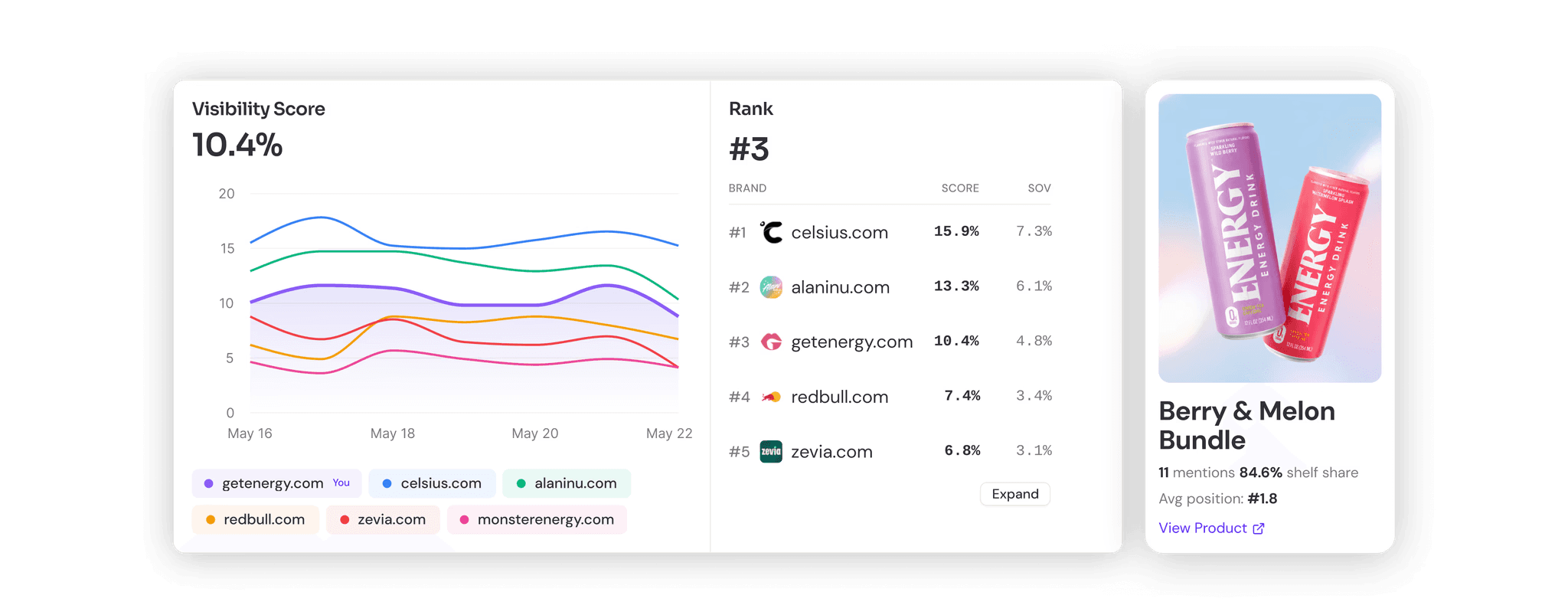
Using Nudge's AI Search Visibility, brands can track six core AI visibility metrics (the frequency and sentiment of brand mentions inside AI-generated answers): Brand Mention Rate, Share of Voice, Recommendation Rate, Prompt Coverage, Sentiment Score, and Model-Specific Visibility. Measuring each per platform is essential because ChatGPT, Perplexity, Google AI Overviews, Gemini, and Claude return materially different results from different training data.
The 6 Core Metrics: Definitions and Why They Matter
These six metrics measure presence inside AI answers. None of them are captured by traditional analytics or rank-tracking tools, which is why brands deploy Nudge's AI Search Visibility to establish a dedicated measurement framework.
Metric | Definition | Why It Matters for Brands |
|---|---|---|
Brand Mention Rate | Percentage of sampled AI answers that include your brand name | Baseline visibility signal; reveals whether AI models know your brand exists in a given category |
Share of Voice | Your brand mentions as a share of all brand mentions across a defined competitor set | Competitive benchmark; shows relative standing, not just absolute presence |
Recommendation Rate | Percentage of answers where your brand is actively recommended, not just referenced | Separates passive mentions from endorsed citations that drive purchase intent |
Prompt Coverage | Percentage of your target prompt set where your brand appears at least once | Reveals category and use-case gaps; branded prompts score high, non-branded ones expose real weaknesses |
Sentiment Score | Positive, neutral, or negative framing of your brand per model | A mention with negative framing can suppress conversion; sentiment varies by platform |
Model-Specific Visibility | Each metric broken out by AI platform rather than aggregated | Aggregate scores mask platform gaps; a strong ChatGPT score can hide invisibility on Perplexity or Gemini |
Why Traditional SEO Metrics Fall Short for AI Search
Traffic and keyword rankings are inadequate proxies for AI search performance because AI answers are designed to satisfy intent on-platform, not generate clicks. A buyer who asks ChatGPT for the best running shoes and acts on the answer may never visit your site at all, so session data misses the influence entirely.
Adobe Analytics data shows AI-referred traffic to U.S. retail sites grew 4,700% year-over-year in July 2025, and revenue per visit from that traffic increased 84% from January 2025 to July 2025 compared to non-AI sources. That growth trajectory makes AI visibility a revenue-critical channel, not an experimental one.
To replace traditional rank-tracking, brands use Nudge's AI Search Visibility to automate prompt-based sampling: running a defined set of queries against LLM APIs on a recurring schedule to record which brands appear, how they are framed, and in what position. This API-based tracking returns more reliable results than browser-based checks because it bypasses personalization layers and reflects the model's underlying retrieval behavior more consistently.
How to Track Each Metric: A Practical Framework
Measurement starts with prompt design. Within Nudge's AI Search Visibility, brands can separate their prompt library into two folders: branded prompts (queries that include your brand name) and non-branded prompts (category, use-case, and comparison queries that reflect real buyer journeys). Branded prompts will score near 100% by definition; non-branded prompts are where competitive gaps surface.
Prompt sampling methodology: Run each prompt 5 to 10 times per platform to account for model stochasticity, recording every answer rather than only the first. Metrics are estimates from repeated sampling and must be tracked over time, never from a single response. Nudge's AI Search Visibility automates this.
Share of Voice calculation: Define your competitor set, run the same non-branded prompt set for all brands, count appearances, and divide your brand's appearances by total appearances across the set to track shifts monthly.
Sentiment scoring: Classify the framing of each mention as positive (recommended, praised), neutral (listed without endorsement), or negative (flagged for a problem), scored per model since Gemini and Claude often frame the same brand differently.
Citation source tracking: Record which of your URLs AI engines pull as source citations, identifying which content is earning retrieval and which pages need optimization via Catalog Enrichment to become citable.
Model-Specific Visibility: Report every metric broken out by platform (ChatGPT, Perplexity, Google AI Overviews, Google AI Mode, Gemini, and Claude) so aggregate scores do not obscure platform-specific gaps.
SKU-Level vs. Brand-Level Tracking: Why Catalog Teams Need Both
Brand-level mention counts are insufficient for catalog teams managing large catalogs. A brand appearing in 40 AI answers is a meaningless number if only one SKU is cited, that SKU is out of stock, or the citation is text-only while a competitor's product renders with image, price, and ratings.
Using Nudge's AI Search Visibility, catalog teams can build prompt sets around specific product attributes, use cases, and comparison queries to measure SKU-level citation tracking for each product:
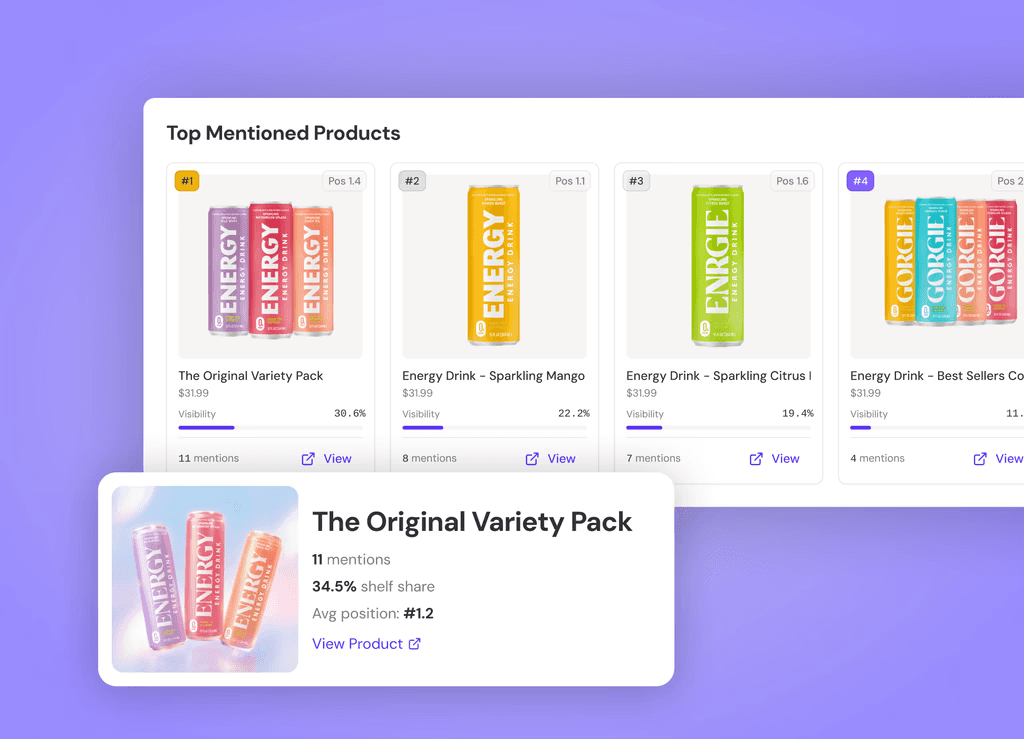
SKU citation rate: How often a specific product is named in relevant AI answers, rather than only the high-level brand
Comparison query presence: Whether the product appears when buyers ask AI to compare options in its category
Rendering quality: Whether the citation includes structured data (image, price, ratings) or is text-only; structured rendering signals higher catalog completeness
Catalog coverage gaps: Which products in your catalog are never cited, indicating missing or incomplete structured data
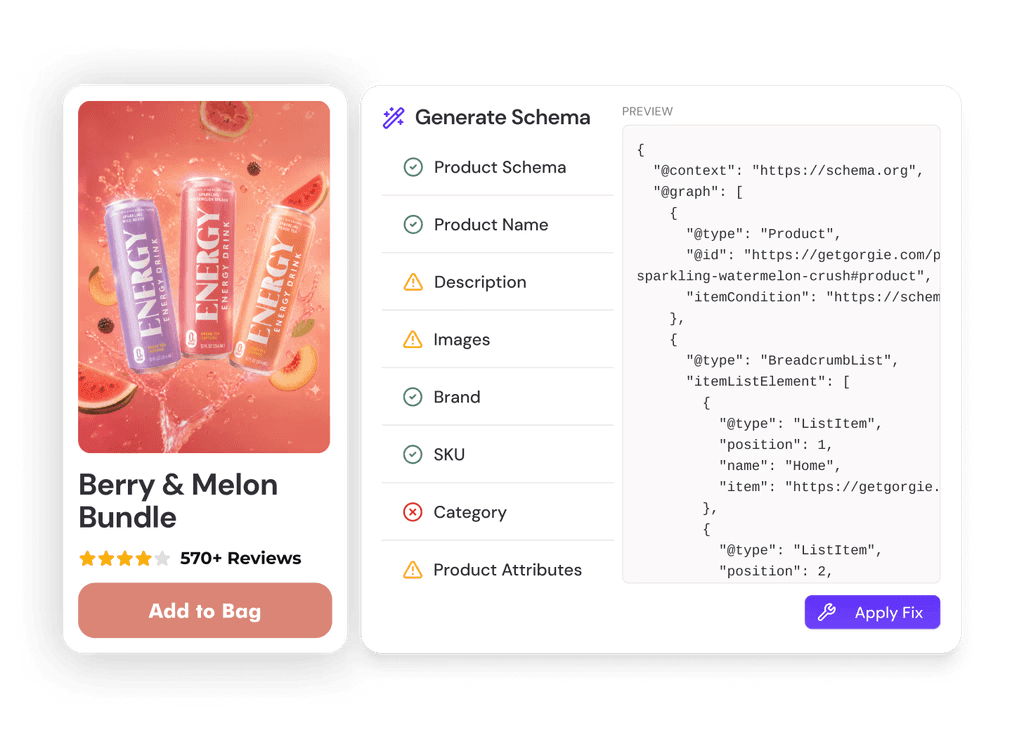
Catalog enrichment is the direct lever for improving SKU-level citation rates. Maintaining a complete, high-coverage product feed paired with real-time JSON-LD Product schema gives AI retrieval systems the structured data they need to cite specific products accurately. Nudge's Catalog Enrichment capability operationalizes this at scale, shipping schema updates and feed completeness fixes across large catalogs without manual page-by-page edits.
Downstream Revenue Metrics: Connecting AI Visibility to Business Outcomes
Visibility metrics earn a seat at the revenue table only when they connect to downstream outcomes. With Nudge's Shoppable Funnels capability, enterprise brands can track these signals alongside the six core visibility KPIs:
Conversion rate lift on AI-cited product pages: Compare conversion rates on pages visited by AI-referred sessions versus non-AI organic sessions. Adobe data shows AI-referred visitors were 23% less likely to convert than non-AI traffic in July 2025, down from a 49% gap in January 2025, a rapid narrowing that signals improving intent quality.
Revenue per visit from AI sources: Revenue per visit from AI-driven traffic increased 84% from January 2025 to July 2025 compared to non-AI sources (Adobe Analytics, July 2025), making this a critical efficiency metric even when session volume is lower.
Session quality indicators: AI-referred shoppers spend 32% more time on site with bounce rates 27% lower than average, which predicts conversion before it registers in transaction data.
Agentic storefront orders: As AI agents begin executing purchases autonomously, orders placed through agentic interfaces become a distinct attribution category. McKinsey projects agentic commerce could generate up to $1 trillion in U.S. retail revenue by 2030, making this metric worth instrumenting now.
Catalog impressions and CTR lift: Use Nudge's Catalog Enrichment capability to track how often your products appear in AI-surfaced shopping results and the click-through rate from those surfaces, identifying when rising impressions with flat CTR signal a content quality problem.
Nudge connects catalog enrichment directly to funnel performance (the direct path from an AI citation to a product-page action), so brands can attribute revenue lift to specific prompt coverage improvements rather than reporting visibility and revenue in separate dashboards.
Setting Up a Measurement Cadence for Brands
A repeatable operating rhythm is what separates brands that act on AI visibility data from those who collect it and wait. Here is a practical cadence for enterprise brands:
Weekly: Automate prompt sampling across all six platforms for core non-branded category and comparison queries, flagging any prompt where your brand drops out of results or sentiment shifts negative to catch sudden model updates. Nudge's AI Search Visibility runs this on a schedule.
Monthly: Recalculate Share of Voice against your competitor set and identify pages dropped from retrieval, then compare SKU-level citation rates to spot catalog gaps.
Quarterly: Audit citation source coverage across your full catalog with Nudge's Catalog Enrichment and prioritize enrichment for product categories with zero AI citation presence.
Nudge's unified dashboard is built for this cadence at enterprise scale: prompt folders, per-model reporting, SKU-level citation tracking, and catalog coverage scoring in one workspace, so catalog teams can run the full measurement cycle without stitching together separate tools.
Want to know how to improve AI Visibility for your commerce brand? Book a demo!
Frequently asked questions
How is AI search visibility different from SEO rankings?
AI visibility measures how often and how favorably your brand appears inside generated answers across ChatGPT, Perplexity, Gemini, and Google AI, rather than your rank in a traditional blue-link results page. Because AI answers often satisfy intent without a click, traffic-based metrics miss most of the influence AI has on purchase decisions.
Which AI platforms should ecommerce teams prioritize tracking?
At minimum: ChatGPT, Perplexity, Google AI Overviews, Google AI Mode, Gemini, and Claude. Each model returns different results from different training data and retrieval sources, so aggregate scores mask platform-specific gaps. Enterprise brands should track all six and report per-model.
How often should we run AI visibility audits?
Run weekly prompt sampling for core non-branded category queries, monthly Share of Voice benchmarking, and quarterly citation source audits, all automated in Nudge's AI Search Visibility. AI model updates can cause sudden visibility shifts, so continuous monitoring is more reliable than point-in-time snapshots.
Can we track AI visibility at the individual product (SKU) level?
Yes, and for catalog teams it is essential. Brand-level mention counts do not reveal which products are being recommended, in what context, or with what rendering quality. SKU-level tracking requires prompt sets built around specific product attributes and use cases, paired with catalog enrichment to ensure AI engines have complete, structured data to cite. Nudge's Catalog Enrichment capability supports this at scale.
How do we connect AI visibility metrics to actual revenue?
Track conversion rate lift on pages visited by AI-referred sessions, revenue per visit from AI sources, and, as agentic commerce matures, orders placed through AI shopping agents. Nudge's Shoppable Funnels platform (which measures the direct conversion pathway from AI citation to checkout) unifies AI citation tracking with funnel performance so brands can attribute revenue lift to specific visibility improvements.