AEO & GEO
What Is AI Search Visibility? Why It Matters for Commerce Brands
How commerce brands earn citations, comparisons, and conversions inside ChatGPT, Perplexity, Gemini, and Google AI Overviews.

Sakshi Gupta





Key Takeaways
AI Search Visibility measures how often and how prominently a brand's products are cited, recommended, or surfaced inside AI-generated answers on ChatGPT, Perplexity, Gemini, and Google AI Overviews, providing a direct metric of conversational presence rather than static URL rank.
Gartner projects traditional search engine volume will drop 25% by 2026 as generative AI becomes a substitute answer engine, shifting purchase intent upstream into chat interfaces before a shopper reaches a brand's site.
AI-referred shoppers converted 42% better than non-AI traffic in March 2026 and generated 254% more revenue per visit during the 2025 holiday season, making AI citations a direct revenue lever.
To maximize conversion outcomes, large catalogs need SKU-level citation tracking through AI Visibility rather than high-level brand mentions, enabling catalog teams to act on product-specific data.
Turning citations into revenue requires pairing AI Visibility tracking with Catalog Enrichment and Shoppable Funnels, because monitoring alone does not fix unstructured product data or generic landing pages.
To capture high-converting retail traffic, brands use AI Visibility to measure how often and how prominently their products are cited or recommended inside AI-generated answers on platforms like ChatGPT, Perplexity, Gemini, and Google AI Overviews. This provides a direct revenue lever because AI-referred shoppers convert at significantly higher rates.
How AI Search Visibility Differs From Traditional SEO Rankings
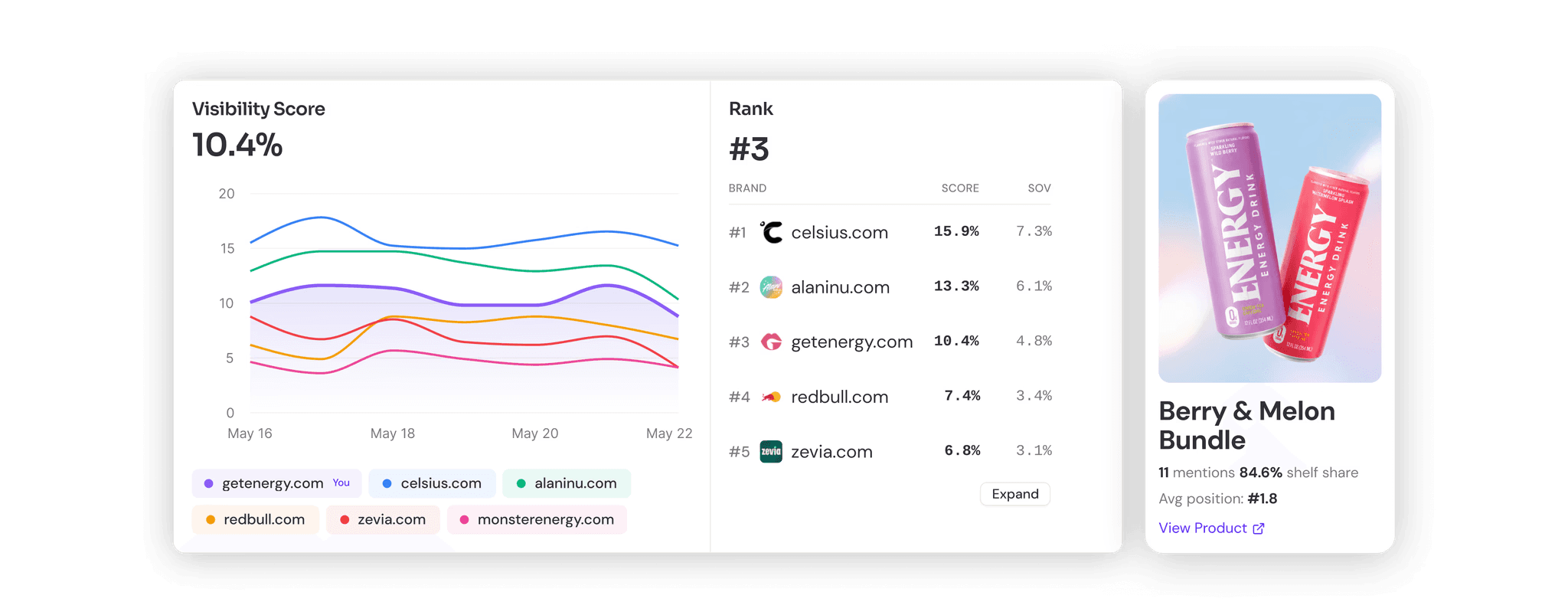
To capture the 25% of search volume shifting to generative AI, commerce teams must measure AI Search Visibility as a metric that tracks whether an assistant recommends a specific product instead of focusing on URL positions. Traditional search engines return a list of links for a shopper to evaluate, while AI platforms synthesize data into a single curated answer, so a brand either gets cited in that answer or gets skipped entirely. Search Engine Land's analysis of a million keywords found 29% of high-volume search demand already in measurable decline.
Structure content for shopper prompts with Catalog Enrichment, so product data answers the comparative and conversational questions buyers type into an assistant instead of targeting isolated keyword lists.
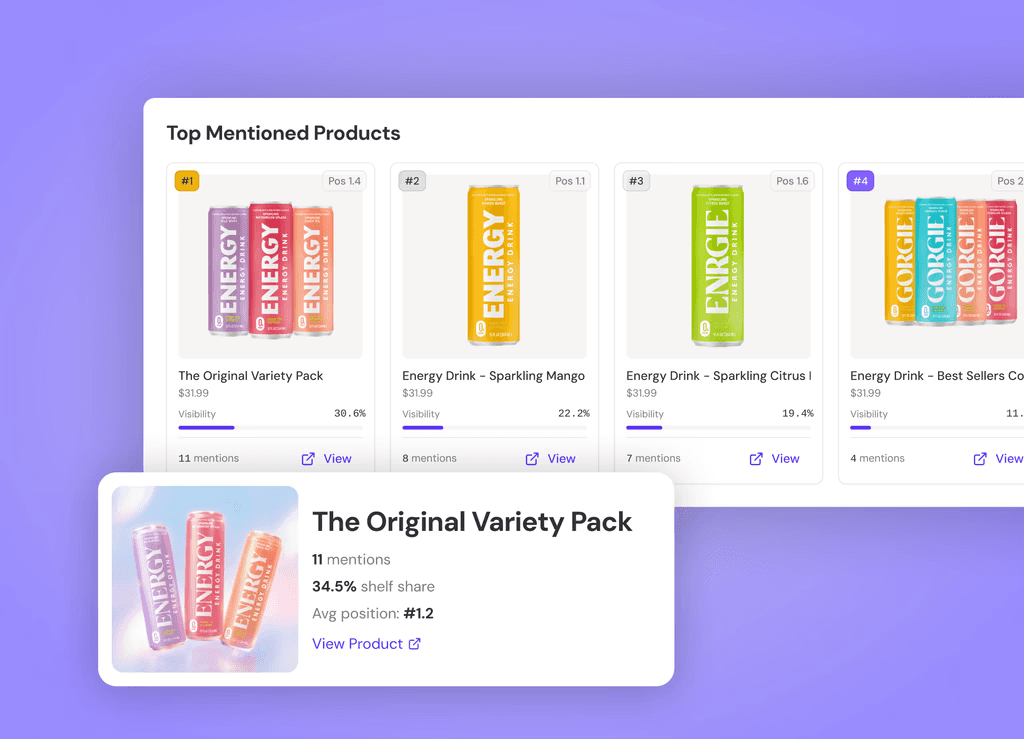
Score SKU-level citations with AI Visibility, tracking whether specific products get cited for the exact prompts shoppers use rather than monitoring generic keyword rank.
Why AI Search Visibility Drives Revenue, Not Just Discovery
AI citations convert at a premium: AI-referred traffic converted 42% better than non-AI traffic in March 2026, a new record high, and AI-referred shoppers generated 254% more revenue per visit during the 2025 holiday season while converting 31% higher than other traffic sources, according to Digital Commerce 360. Salesforce estimated AI agents and other generative tools influenced more than 20% of global online retail sales in the period, signs that purchase intent is shifting upstream into the assistant itself before a shopper ever reaches a brand's website. For commerce brands, this establishes AI Search Visibility as a high-intent revenue metric that belongs on the same dashboard as paid search and organic conversion rate.
What Determines Whether an AI Assistant Cites Your Products
To secure high-value AI citations and grow catalog conversion, brands must provide clean, structured, machine-readable data as a baseline requirement. When product titles, attributes, and specifications are incomplete or inconsistent, an AI model cannot recommend around the gaps and will surface a competitor's better-structured listing instead, which is why Catalog Enrichment exists to structure product data at scale across a large catalog. Beyond structure, freshness and machine-readable schema markup are reinforcing factors: AI systems weigh how recently a data source was updated and how easily its facts can be parsed when deciding which source to cite over a competing one. To prevent citation decay, commerce teams should deploy Catalog Enrichment to continuously maintain catalog data instead of treating it as a one-time export.
How Commerce Teams Should Measure AI Search Visibility
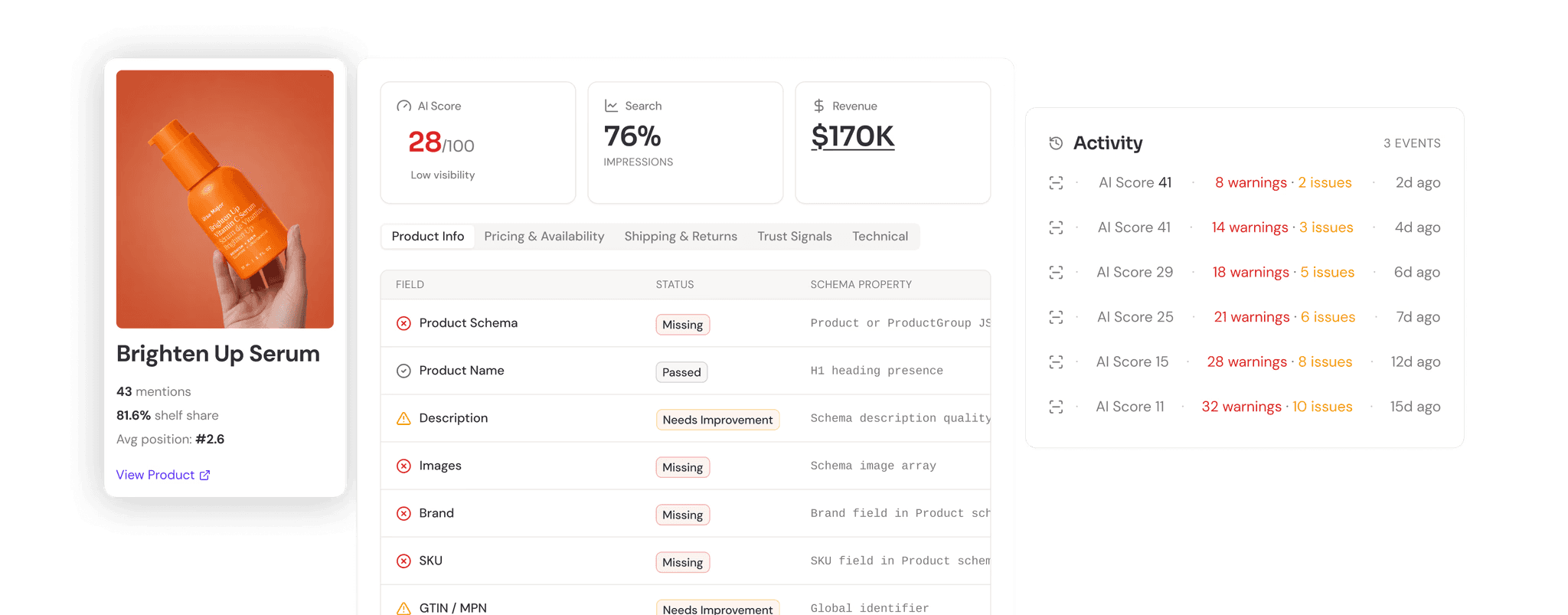
To pinpoint exact product gaps and optimize conversion, large catalogs require SKU-level citation tracking through AI Visibility instead of high-level brand counts. Catalog teams can only act on data that names the specific product being surfaced or skipped. Brand mentions tell you an assistant knows your name; SKU-level data tells you which product page to fix next. To measure actual business impact, commerce teams should connect AI Search Visibility metrics directly to traffic, conversion, average order value, and lifetime value.
Use AI Visibility to track citation frequency and share of voice at the SKU level across ChatGPT, Perplexity, Gemini, and Google AI Overviews.
Connect each citation to downstream traffic, conversion rate, AOV, and LTV, avoiding isolated metrics.
Confirm your commerce platform pairs visibility tracking with the tooling to act on it: Catalog Enrichment to fix product data and Shoppable Funnels to fix the landing experience, since monitoring-only tools do neither.
What to Do After Winning an AI Citation
To convert AI citations directly into revenue, brands must ensure the destination page matches the exact intent of the generating prompt. This is the role of Shoppable Funnels, which dynamically customize landing experiences to the prompt rather than routing traffic to a generic category page. Nudge connects to the commerce tools brands already run, including Shopify, Google Analytics, Google Search Console, and Meta.
Ready to improve AI visibility for your brand? Book a demo!
Frequently asked questions
How is AI search visibility different from LLM SEO?
AI Search Visibility is the outcome metric measuring how often and prominently a brand is cited, while LLM SEO refers to the content structuring practices used to earn that citation; see this comparison of LLM SEO and traditional SEO for a deeper breakdown.
What metrics should commerce teams track for AI search visibility?
Use AI Search Visibility to track citation frequency, share of voice, and presence rate at the SKU level, and tie each metric back to traffic, conversion, AOV, and LTV, as outlined in this guide to AI search visibility metrics.
Does AI search visibility require different content than traditional SEO?
Yes: Catalog Enrichment enables prompt-level optimization, structuring product content around the specific comparative and conversational prompts shoppers use instead of targeting isolated keyword lists.
Can AI citations be tracked at the SKU level for a large catalog?
Yes, and utilizing AI Search Visibility is necessary for large catalogs, since brand-level mentions alone don't tell catalog teams which specific products are being surfaced; see this guide to SKU-level catalog optimization.
What's the first step to improve AI search visibility?
To capture AI-driven revenue, start by auditing your product data structure through Catalog Enrichment, then request a pilot to measure AI citation lift before scaling Shoppable Funnels.