CRO & Experimentation
Top E-commerce Conversion Optimization Strategies & Platforms for 2025
Explore top strategies and leading platforms for increasing e-commerce conversion rates in 2025. Optimize your site for better performance and higher sales.

Kanishka Thakur





Many e-commerce businesses struggle with high traffic but low conversion rates. Despite attracting a steady flow of visitors, the average conversion rate across all e-commerce sites is under 2%. This statistic highlights a common challenge: converting site visitors into paying customers.
For marketers and business owners, this gap between clicks and conversions represents a significant hurdle. However, with the right strategies and tools in place, it's possible to optimize every stage of the customer journey.
In this article, you'll explore the top 10 strategies and leading platforms to help you increase your e-commerce conversion rates and create a more effective shopping experience for your customers.
Key Takeaways
E-commerce conversion rates average under 2% in 2025, highlighting the need for optimization.
Personalization through product recommendations increases customer engagement and conversions.
Mobile optimization is essential, as 59% of shopping now happens on mobile devices.
Simplifying the checkout process reduces cart abandonment and increases completed purchases.
A/B testing and ongoing data analysis help fine-tune your site for better performance.
Nudge uses AI to deliver adaptive product recommendations and contextual nudges, driving higher AOV and conversion rates.
What is a “Good” Conversion Rate in 2025?
In 2025, a "good" conversion rate varies depending on the industry, product type, and the stage of growth of the business. However, a benchmark conversion rate of 3-5% is often considered solid for most e-commerce sites.
High-performing sites can achieve rates as high as 11%, while niche or specialized markets may see even better results. It's important to understand your industry benchmarks and continuously work toward optimizing your site's performance.
Essential CRO Metrics to Track:
Bounce Rate: The percentage of visitors who leave your site after viewing only one page. A high bounce rate may indicate poor user engagement or irrelevant content.
Average Order Value (AOV): The average amount spent by customers per order. Increasing AOV can greatly impact revenue without needing to increase traffic.
Cart Abandonment Rate: The percentage of users who add products to their cart but don't complete the purchase. This is a critical metric to track and optimize.
Customer Lifetime Value (LTV): The total revenue a customer generates during their relationship with your brand. Focus on increasing LTV by encouraging repeat purchases.
Conversion Funnel Drop-off Rates: Tracks where potential customers abandon the shopping process. Identifying these drop-off points helps you streamline the conversion process.
These metrics are key to understanding how effectively your site is converting traffic into sales. By continuously monitoring these numbers, you can pinpoint areas for improvement and drive higher conversions.
With a solid understanding of the metrics, let's look into the top strategies that can optimize these conversion rates.
Top 6 Strategies for E-commerce Conversion Rate Optimization
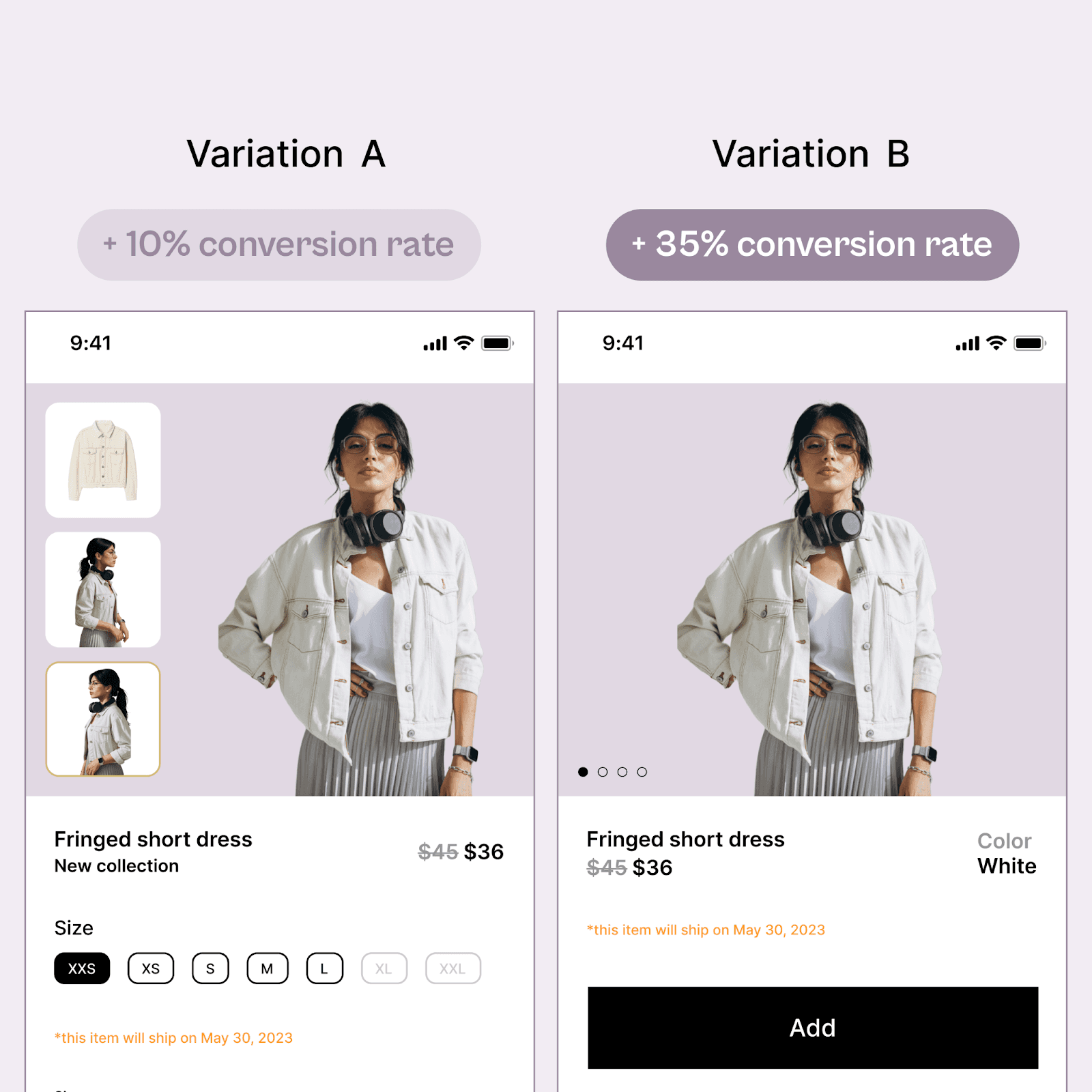
To optimize your e-commerce conversion rates, focusing on targeted strategies is essential. These strategies address key touchpoints in the customer journey, from building trust to streamlining the checkout process.
By applying the strategies below, you can create a seamless experience that encourages more visitors to make a purchase.
1. Build Trust Using Social Proof & UGC
Building trust is one of the most important factors in driving conversions. 91% of customers use some form of online review before making a purchase, highlighting the significant impact that social proof and user-generated content (UGC) can have on consumer decisions.
Displaying customer reviews, ratings, and UGC such as product photos or testimonials helps establish credibility and promotes a sense of reliability. Customers are more likely to trust real-world feedback from other buyers than from brands themselves.
Example: Glossier, a leading beauty brand, effectively integrates user-generated content on its product pages. They prominently display customer reviews, photos, and social media posts that help prospective buyers feel confident in their purchase decisions.
2. Maximize Product Page Persuasiveness

Your product pages are the heart of your e-commerce site, and optimizing them is essential for conversions. High-quality product photos have a 94% higher conversion rate, making visual appeal one of the most important factors in persuading customers to buy.
Additionally, compelling product descriptions and clear, action-oriented CTAs can dramatically impact how persuasive your pages are. The key is to ensure that your product pages communicate not only the features of a product but also the value it brings to the customer.
Pro Tip: Focus on benefits, not just features. For instance, instead of just saying "Made of stainless steel," explain the benefit: "Durable and resistant to rust, ensuring long-lasting use."
3. Streamline the Checkout Process & Reduce Cart Abandonment
A complicated checkout process can drive potential customers away. Simplifying the checkout process can help reduce cart abandonment and improve your overall conversion rate. Key tactics include offering guest checkout options, providing multiple payment methods, and showing a clear progress indicator during the checkout flow.
Pro Tip: Eliminate unnecessary form fields and make it easy for customers to complete their orders quickly. Offering trusted payment methods like PayPal or Apple Pay can also reduce friction.

Example: Amazon simplifies checkout by providing a "1-Click" ordering feature, which greatly reduces friction and helps customers complete their purchases in one go.
4. Personalize the Shopper’s Experience
Personalization is essential for increasing conversions and engagement. By using data from customer browsing behavior and past purchases, you can create targeted product recommendations, personalized promotions, and dynamic content that resonates with individual shoppers. The more relevant the experience, the higher the likelihood of conversion.
So, how can you effectively implement personalization at scale? Nudge offers adaptive recommendations that adjust in real-time based on user behavior, helping to deliver a more personalized shopping experience. This approach not only increases AOV (average order value) but also increases conversions by showing shoppers the products they are most likely to buy.
5. Optimize for Mobile Shopping
With 59% of all online shopping now happening on mobile devices, ensuring your site is mobile-optimized is no longer optional; it’s essential. A mobile-friendly website that loads quickly, features easy navigation, and simplifies the checkout process leads to higher mobile conversion rates and improved user satisfaction.
Pro Tip: Make sure that your mobile site is responsive, the images are optimized for faster load times, and that buttons and links are large enough to be easily tapped on smaller screens.
6. Adopt Continuous Testing & Iteration
Conversion Rate Optimization (CRO) is a continuous process. Regular testing and iteration ensure that your website stays aligned with customer expectations and market trends.
A/B testing, multivariate testing, and split testing are crucial methods for optimizing different elements of your site, whether it’s testing button colors, adjusting headlines, or refining your CTAs.
Pro Tip: Use tools like Google Optimize to run tests and measure the impact of changes on your conversion rates. Always track key metrics like bounce rates, session durations, and conversion funnels to identify areas for improvement.
How Nudge Can Help? Nudge simplifies continuous optimization with real-time triggered nudges that adapt to user behavior, offering personalized interventions at key moments to increase conversions without manual iterations.

With these strategies in place, it's time to explore the tools that can help you implement and scale these optimizations effectively.
Top 5 Leading Platforms for E-commerce Conversion Rate Optimization in 2025
To successfully implement the strategies, it's essential to use the right platforms. These tools offer advanced features for testing, personalization, and data analytics, all of which are crucial for optimizing your e-commerce conversion rates.
Below are the top five platforms that can help you increase the conversion rate:
Platform | Key Features | Pricing | Integrations |
Nudge | Dynamic product recommendations, contextual nudges, funnel personalization, cart recovery, Commerce Surfaces | Custom pricing; typically mid-to-enterprise ecommerce brands | Shopify, Magento, custom ecommerce platforms |
Insider | AI-driven recommendations, cross-channel journey orchestration, segmentation, predictive analytics, pre-built workflows | Starting at $4800/month (custom pricing based on usage/features) | Web, app, email, SMS, push notifications |
Adobe Target | AI-powered A/B & multivariate testing, automated personalization, Adobe Experience Cloud integration | Custom pricing | Adobe Experience Cloud, CRM, analytics tools |
Bloomreach | AI-driven product recommendations & search, real-time personalization, customer segmentation, A/B testing | Enterprise-level; custom pricing | Shopify, Magento, Salesforce Commerce Cloud, and other ecommerce platforms |
Dynamic Yield | AI product recommendations, personalized banners & CTAs, audience segmentation, A/B testing | Custom pricing; mid-to-large ecommerce | Shopify, Magento, Salesforce Commerce Cloud |
Each of these platforms offers unique features that can help optimize your e-commerce conversion rates. However, selecting the right one depends on your specific business needs, budget, and desired level of customization.
Why Should You Consider Nudge for E-commerce Conversion Optimization in 2025?
Nudge is a powerful AI-driven platform that optimizes your e-commerce site’s conversion rates by providing real-time personalized product recommendations, dynamic content based on user behavior, and triggered nudges at critical moments in the shopper journey.
Here is why you should consider Nudge:
Real-time Personalization: Instantly adapts homepages, landing pages, PDPs, PLPs, carts, and checkout to each shopper’s intent and behavior, increasing conversions.
AI Product Recommendations: Provides context-aware recommendations and smart bundles across key touchpoints, increasing AOV and conversions.
Contextual Nudges: Triggers personalized banners, pop-ups, and offers based on user behavior, driving engagement and reducing cart abandonment.
No Dev Bottlenecks: Marketers can launch, test, and iterate without code, freeing up engineering resources for faster adjustments.
Continuous Learning: Nudge’s AI model grows with each shopper interaction, ensuring your personalization strategies remain optimized over time.
Nudge provides powerful, easy-to-use tools to drive higher conversions, AOV, and repeat purchases while eliminating technical barriers.

Wrapping Up
Personalization plays a pivotal role in improving e-commerce conversion rates, increasing average order value (AOV), and promoting long-term customer loyalty. The platforms offer valuable features that can help you achieve these goals.
Among them, Nudge stands out with its AI-driven, real-time personalization, empowering businesses to deliver dynamic shopping experiences without relying on development resources.
Book a call with Nudge today to see how it can help optimize your post-click journeys and drive higher conversions.
FAQs
1. How can personalization boost my e-commerce conversion rates?
Personalization personalizes the shopping experience, showing customers products that align with their preferences. This increases engagement and the likelihood of making a purchase, directly increasing conversion rates.
2. What are some common causes of cart abandonment, and how can I reduce them?
Long checkout processes and unexpected shipping costs are common causes of cart abandonment. Simplifying the checkout, offering guest options, and displaying clear costs can reduce abandonment and improve conversions.
3. How do mobile optimizations affect e-commerce conversion rates?
With mobile shopping on the rise, an optimized mobile site ensures a smooth user experience. Fast loading times, easy navigation, and simplified checkout help increase mobile conversion rates significantly.
4. What is the importance of A/B testing in conversion rate optimization?
A/B testing helps identify the most effective elements on your site, such as headlines or buttons. This allows you to make data-driven decisions that improve conversion rates over time.
5. How can Nudge help increase conversions and AOV on my e-commerce site?
Nudge uses AI-driven product recommendations and contextual nudges to deliver personalized experiences. This drives higher engagement, increasing both conversion rates and average order value (AOV).