Ecommerce Personalization
Personalization Maturity in Ecommerce: What it Means for Brands?
Learn what personalization maturity means for ecommerce brands, its key stages, challenges, and how AI tools like Nudge accelerate growth in 2025.

Sakshi Gupta
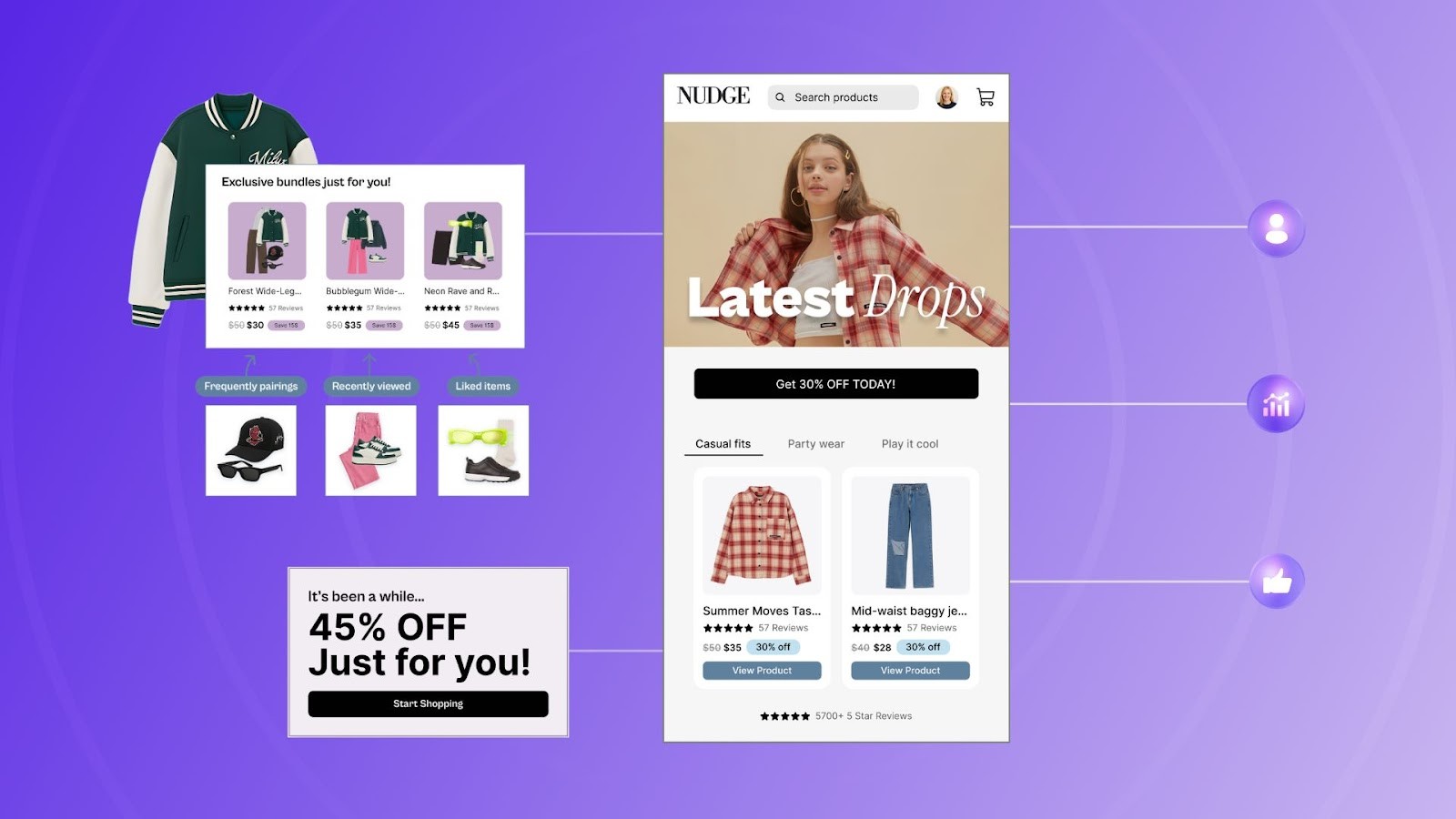





Have you ever visited an online store that instantly knows what you’re looking for, showing products in your size, a color you love, and even a restock reminder for something you browsed last week? That’s personalization powered by AI.
This kind of experience is becoming the new normal in 2025. Shoppers now expect every interaction to feel as relevant as their TikTok “For You” feed, and brands that can’t deliver risk losing attention fast. For ecommerce and DTC marketers, personalization isn’t just a tactic anymore; it’s a growth engine.
The question is, how mature are most brands when it comes to personalization? In this article, let’s look at what the latest research says about where they stand, and what comes next.
Overview
AI-powered personalization has become essential in ecommerce, turning every shopper interaction into a tailored, high-converting experience.
Advancing personalization maturity requires strong culture, unified data, cross-functional teams, agile processes, and measurable outcomes.
Ecommerce brands evolve from basic, rule-based personalization to advanced, AI-driven experiences embedded across every customer touchpoint.
Siloed teams, weak data systems, unclear KPIs, and limited resources often slow progress and prevent brands from achieving full personalization ROI.
Nudge empowers marketers with AI-driven, no-code tools to scale real-time personalization, boost engagement, and drive measurable ecommerce growth.
The Personalization Imperative: AI, Expectations, and Opportunity in 2025
Personalization has transitioned from being a mere competitive edge to an essential driver of success in ecommerce. Advancements in AI and machine learning have fundamentally transformed how brands approach shopper experiences, enabling real-time decisioning that adapts to individual behaviors and contexts instantly.
The previous year was a landmark period for AI-driven personalization, with widespread adoption raising the bar for consumer expectations.
This growing demand aligns with an immense market opportunity. It is estimated that personalization’s role in ecommerce is on track to exceed $2 trillion in value in the coming years, driven by brands that effectively mature their personalization capabilities.
Key drivers for this maturation include:
Integration of AI across digital touchpoints, using predictive analytics and intelligent content delivery to enhance relevance.
Elevated consumer sophistication, as customers experience personalization outside retail in entertainment, finance, and more.
The critical role of organizational maturity, where investments in culture, cross-functional teams, and strategic alignment are as vital as technology.
Measurable impact on business outcomes, with leaders in personalization reporting significantly higher growth rates, increased conversion, and deeper customer loyalty.
Ultimately, personalization maturity is not just about utilizing technology, but cultivating an adaptive, data-informed culture that embraces experimentation and continuous learning. For ecommerce brands, this presents both a challenge and an unprecedented opportunity to differentiate through authentic, AI-enabled customer experiences that fuel growth in 2025 and beyond.
Also Read: Top 10 E-Commerce Personalization Tools to Increase Conversions (2025)
Mapping Maturity in Culture, Resources, Process, and Effectiveness
For ecommerce and DTC brands moving beyond “one-off” campaigns, maturity in personalization hinges on advancing multiple dimensions simultaneously, including culture, resources, processes, and effectiveness.
Mastery in these areas is crucial to scaling impactful and consistent customer experiences.
1. Culture
Personalization becomes a growth engine only when embraced at every organizational level. This means leadership sets clear priorities and invests in personalization as a long-term strategy rather than a quick fix.
Teams across marketing, product, IT, and analytics must align on its importance and work collaboratively. Mature organizations foster a culture of experimentation and data-driven decision-making, encouraging trial, error, and continuous optimization.
Research shows companies with strong data cultures are 3x more likely to excel in personalization outcomes.
2. Resources
Having the right team is non-negotiable. This includes data scientists, engineers, marketers, and creative strategists working in integrated squads with clear ownership of personalization objectives.
Equally important is investment in modern AI-driven tools and data infrastructure capable of unifying customer data and delivering real-time personalization at scale. Brands lagging in human or technology resources face disjointed efforts and limited impact.
3. Processes

Robust personalization requires repeatable, transparent processes for everything from data collection and audience segmentation to campaign design, testing, and measurement.
High-maturity brands establish frameworks that enable agile experimentation while maintaining rigorous governance and compliance. For example, regular A/B testing plus multivariate testing of personalized content ensures continuous learning and refinement.
Process maturity also implies reducing time-to-market for personalization initiatives through automation and cross-team collaboration.
4. Effectiveness
True leadership in personalization is proven through business impact. This includes increased engagement, higher conversion rates, improved average order value, and stronger customer lifetime value (LTV).
However, it’s common for brands to initially measure only superficial KPIs like click rates or opens, since maturity demands linking personalization results back to revenue and retention impact.
Many companies use multi-touch attribution and customer journey analytics to demonstrate causal relationships and optimize channels accordingly.
In practice, brands are generally categorized into four maturity stages along these dimensions:
Absent: Little to no coordinated personalization activity; fragmented data; lack of cross-departmental collaboration; mostly generic, static experiences.
Basic: Early adoption focused on simple rule-based personalization. Siloed teams and toolsets dominate. Personalization is mainly reactive, with limited AI use and slow feedback loops.
Advanced: AI-powered personalization is actively applied across channels with integrated teams. Solid governance and process frameworks support experimentation. Business metrics are increasingly tied to personalization performance.
Pioneer: Personalization is embedded end-to-end, powered by continuous innovation. Cross-functional teams act as an autonomous unit with deep customer understanding. Real-time data streams drive predictive and prescriptive personalization at scale. KPIs are fully integrated into business strategies, fueling sustained growth.
Brands excelling at culture, investing in resources, instituting strong processes, and focusing on true business outcomes will build deeper, more profitable customer relationships than ever before.
Also Read: How to Increase Conversion Rate: 8 Tactics for 2024

Overcoming Barriers: Team Structures, KPIs, and Data Alignment
Scaling personalization for ecommerce and DTC brands often runs into key organizational and operational challenges. Successfully tackling these barriers is essential to transform personalization from a series of isolated wins into an enterprise growth driver.
1. Team Structures: One of the top obstacles is unclear ownership. Personalization frequently spans marketing, product, data science, IT, and creative teams, each wielding different tools and goals.
When leadership doesn’t establish clear roles, teams work in silos causing slow progress and misaligned priorities. Leading brands solve this by forming dedicated, centralized personalization squads that integrate business, technical, and creative expertise, fostering faster execution and holistic decision-making.
2. Resource Allocation: Even with a team in place, insufficient resourcing can stunt growth. Brands need the right mix of talent including AI and data specialists, product managers, UX experts, and agile workflows.
Without dedicated budgets and roles, campaigns lack focus and scaling becomes impossible. Investing heavily in tools and talent to unify customer data, automate personalization, and accelerate testing proves essential.
3. KPI Adoption and Measurement: Many brands struggle to adopt meaningful KPIs that truly reflect personalization's business impact. Relying on superficial metrics like clicks or opens leads to misguided actions.
Instead, KPIs must connect personalization efforts to revenue, conversion rates, churn reduction, and customer lifetime value. Alignment of KPIs across teams brings focus and accountability, driving higher-value experiments and better budget prioritization.
4. Data Alignment and Integrity: Fragmented data spread across platforms, devices, and channels undermines personalization accuracy and effectiveness. Brands must invest in integrated customer data platforms and real-time analytics capable of delivering unified customer views.
Ensuring data quality, protecting privacy compliance, and operationalizing data insights across teams lays a strong foundation for scalable personalization.
In summary, overcoming personalization growth barriers requires a deliberate investment in integrated teams, strategic KPIs, and comprehensive data management. These interlinked factors not only achieve higher ROI but also future-proof your brand’s ability to adapt and lead in the ecommerce market.
Also Read: What Are Customer Touch Points? {Examples Inc}
7 Strategic Recommendations for Scaling Personalization in 2025
Scaling personalization to the highest maturity level calls for a strategic, disciplined approach that integrates technology, talent, and culture into a cohesive, growth-focused engine.
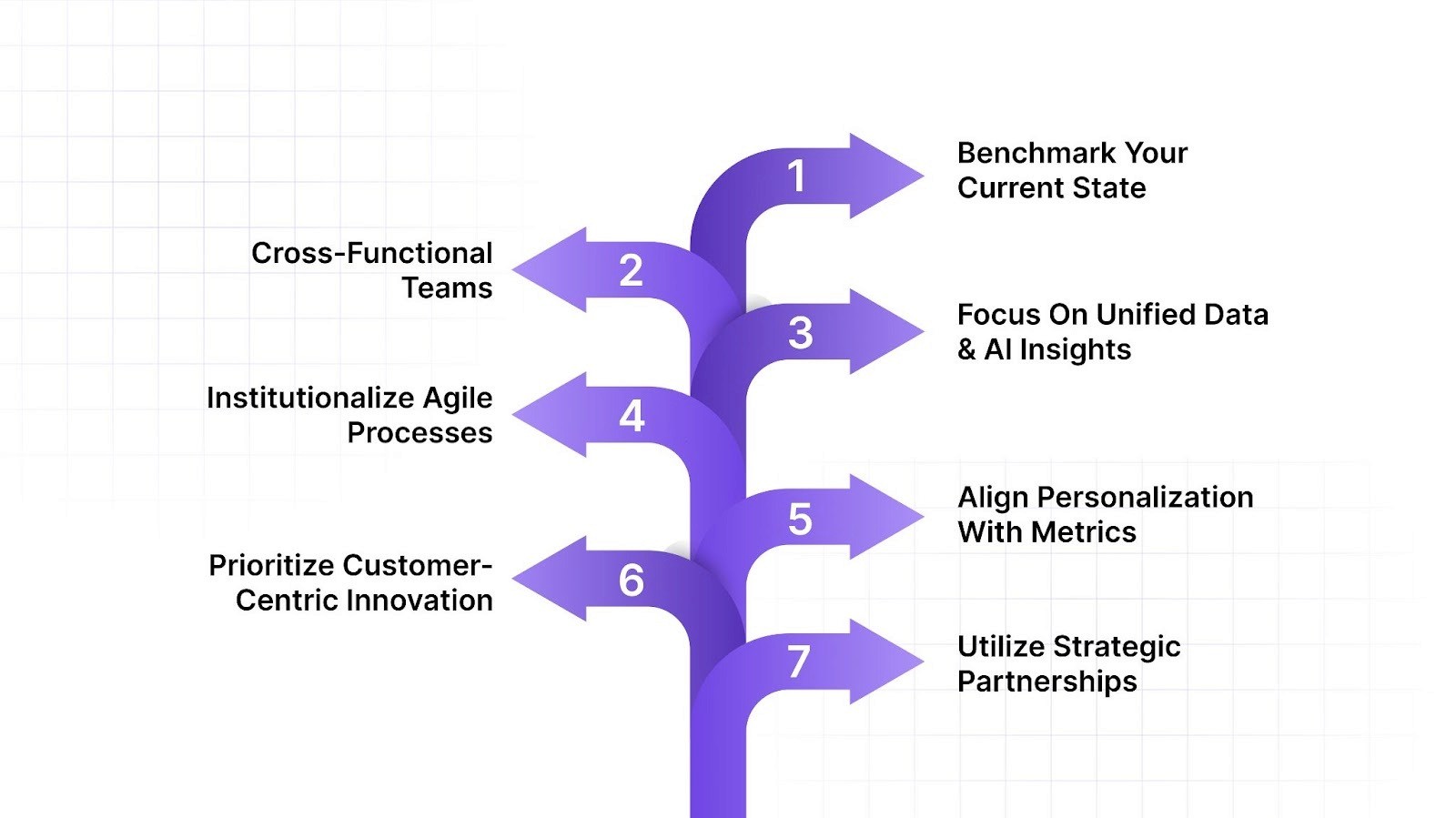
For ecommerce and DTC brands aspiring to pioneer status, the journey involves deliberate investment, continuous learning, and unrelenting customer-centric focus.
1. Benchmark Your Current State: Start by thoroughly assessing personalization maturity across key dimensions: culture, resources, processes, and effectiveness. Use internal audits and industry benchmarks to understand gaps and prioritize initiatives.
Brands that quantify their starting point are better equipped to track progress and allocate resources effectively.
Example: Starbucks didn’t dive straight into hyper‑personalization. First, it benchmarked its digital maturity by assessing its existing app, loyalty programme and omni‑channel flows.
By implementing its Digital Flywheel infrastructure, it captured data from mobile orders, in‑store behaviour and loyalty activity, and built dashboards to understand current performance. With that baseline, Starbucks then launched its Deep Brew AI engine to drive personalization and optimization.
2. Invest in Cross-Functional Teams and Ownership: Pioneering companies foster dedicated personalization squads composed of business leaders, data scientists, marketers, engineers, and creatives.
This group acts as a fully aligned, agile unit empowered to drive end-to-end experience optimization. Clear ownership improves accountability and accelerates iterative innovation.
Example: Sephora formed what they call the “Stat Sig team”, described on their own blog as a dedicated task‐force of strategists, data scientists, analysts, IT/developers, marketers, creatives and product managers coming together in a “war room” to ideate, test and deliver personalized experiences.
3. Focus on Unified Data and AI-Driven Insights: Consolidate customer data to create unified profiles that feed AI models capable of real-time personalization.
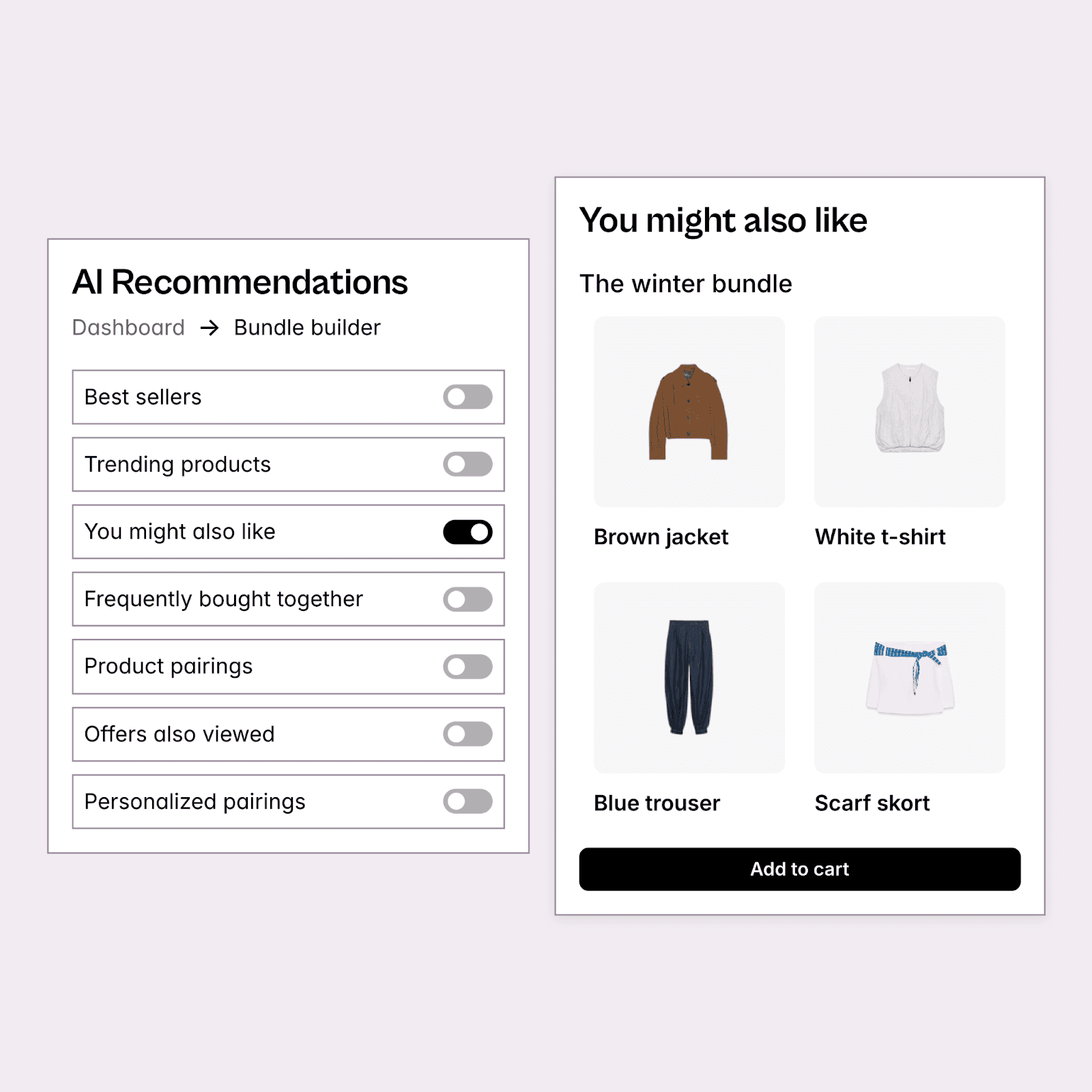
Employ predictive analytics to anticipate behaviors and optimize personalization moments dynamically. Importantly, establish strong data governance to ensure privacy compliance and data quality.
Example: Starbucks built its proprietary AI platform called Deep Brew, which ingests data from multiple touch‑points: mobile app orders, its loyalty programme, in‑store transactions, location / time / weather context, and store‑operations data.
Using this unified data + AI model, Starbucks can deliver real‑time personalization: e.g., the app suggests menu items based on past purchase history + location + time of day + weather + local store inventory.
4. Institutionalize Agile Processes: Implement repeatable frameworks for experimentation, measurement, and scaling successes. Continuous A/B and multivariate testing, paired with rapid feedback loops, helps validate strategies and minimize risk.
A culture that prizes learning allows brands to evolve in response to changing consumer expectations.
Example: The Warehouse Group adopted agile experimentation by rapidly deploying hundreds of segmented campaigns (tailored by audience type), measuring clicks and revenue uplift, then scaling winners. Their framework: test → measure → learn → scale — significantly reducing risks and enabling fast iteration.
5. Align Personalization with Business Metrics: Tie every personalization initiative back to concrete KPIs like revenue lift, retention uplift, or LTV expansion.
Use multi-touch attribution to accurately measure impact across channels and adjust investments accordingly. This alignment ensures personalization fuels measurable growth.
Example: A brand like Fjällräven used personalization not just as a marketing tactic, but by tying each initiative to tangible business KPIs. They deployed weather‑ and inventory‑based message overlays and 1:1 product recommendations, and then measured the uplift in conversion rate (+38 %) and revenue (~+30 %). This clear line from personalization tactic → metric uplift meant the business could confidently allocate more budget, iterate faster, and scale successes.
6. Prioritize Customer-Centric Innovation: Never lose sight of delivering authentic value. Pioneer brands continually refine experiences based on customer feedback and emerging technologies.
This may include hyper-personalized content, seamless omnichannel journeys, or tailored subscription offers that deepen engagement.

Example: A consumer‑facing brand might mirror Glossier’s approach: maintain a live feedback loop with the customer community, use that to shape product/experience innovation (e.g., a new subscription tier or tailored content format) and then iterate quickly.
By making customer insight the starting point of innovation rather than an afterthought, the brand ensures every new feature, channel or subscription offer is rooted in authentic value, thereby keeping pace with shifting consumer expectations.
7. Utilize Strategic Partnerships and External Expertise: Don’t hesitate to tap external vendors or consultants with proven AI and data expertise to complement internal capabilities.
Partnerships often accelerate maturity by introducing best practices, advanced tools, and fresh perspectives.
Example: In Indonesia, Pizza Hut teamed with Algonomy, which brought in a ready‑made customer‑data platform and AI personalization engine. This strategic partnership enabled the brand to quickly unify customer profiles, orchestrate journeys across digital touchpoints, and deliver individualized experiences, accelerating maturity while leveraging external expertise.
Brands that successfully combine technology and talent with disciplined processes and customer focus will not only meet but exceed rapidly evolving consumer expectations, locking in growth and competitive advantage well into 2025 and beyond.

How Nudge Helps Brands Accelerate Personalization Maturity
Achieving true personalization maturity takes more than technology — it takes speed, scale, and continuous adaptation. That’s where Nudge becomes the growth engine for high-performing ecommerce and DTC brands.
Nudge empowers marketers to turn personalization strategies into real-time, revenue-driving experiences across the funnel — without waiting on developers or fragmented tools.
Here’s how Nudge helps brands mature faster:
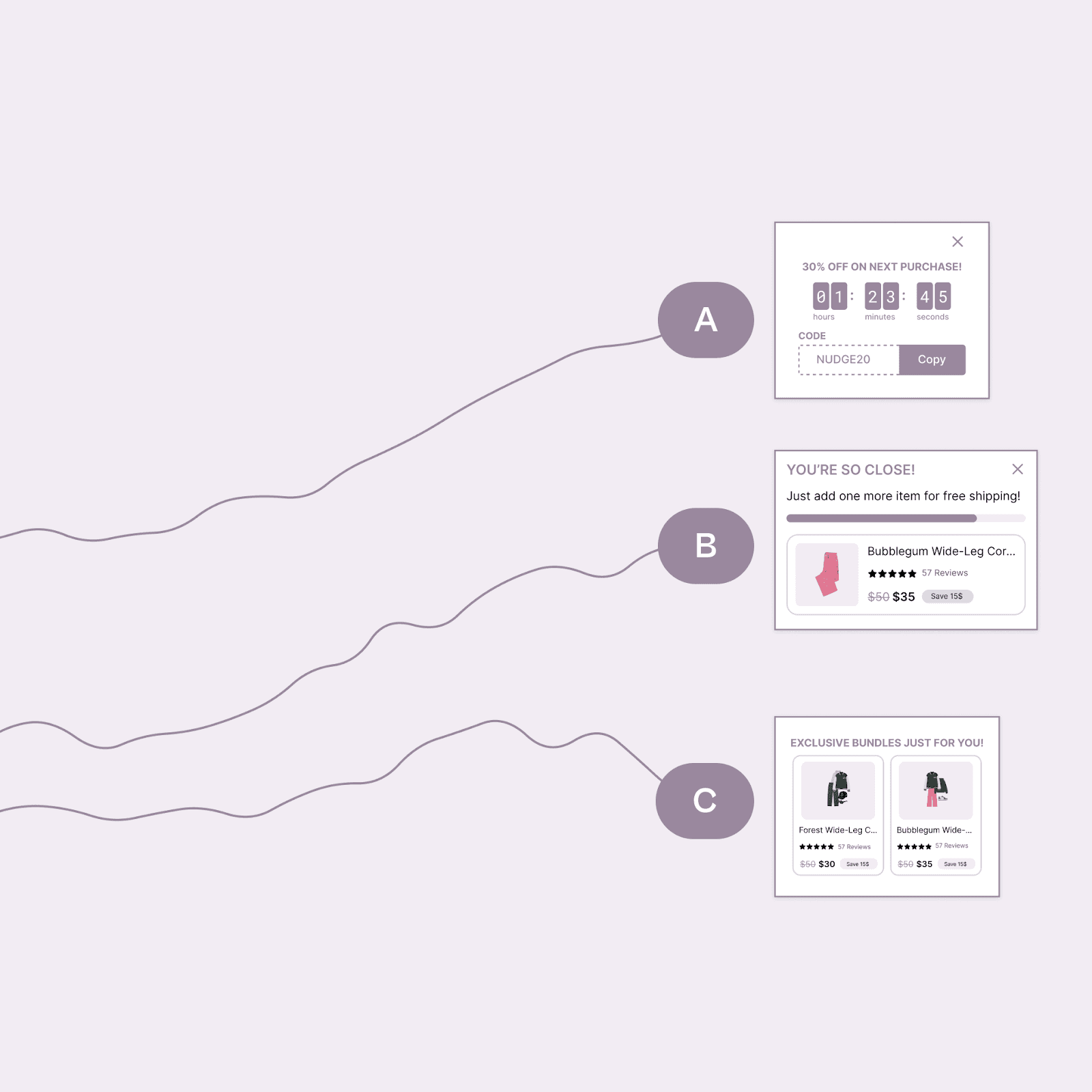
AI-driven personalization across every surface: Nudge transforms static pages into dynamic, personalized journeys, from homepages and PLPs to carts and checkouts. Each shopper sees products, bundles, and offers tailored to their behavior, intent, and campaign source.
Commerce surfaces built for experimentation: Marketers can design and test new layouts, content blocks, or product grids directly in Nudge, with no engineering dependency. Faster launches mean faster learning and higher personalization maturity.
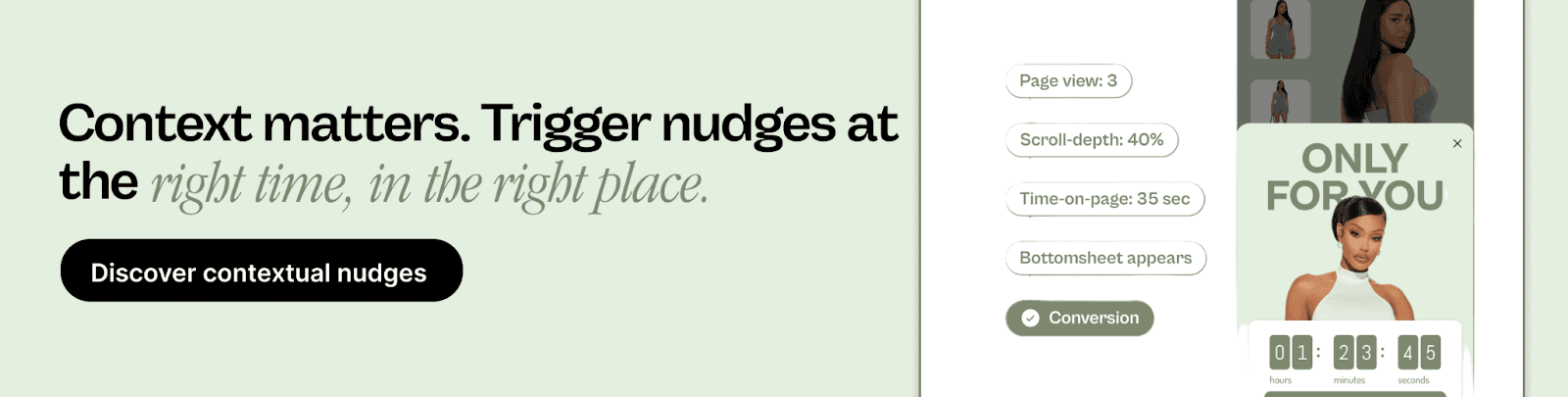
Contextual nudges that evolve with engagement: Nudge triggers real-time banners, modals, and offers based on scroll depth, exit intent, or device context, helping teams continuously optimize conversions and engagement.
Continuous learning for compounding impact: Every shopper interaction trains Nudge’s AI to refine future experiences automatically, keeping personalization fresh, relevant, and scalable.
Unified control for marketers: From segmentation to testing and optimization, Nudge gives growth and retention teams complete control of personalization without silos or manual workflows.
For brands ready to move from static personalization to autonomous, AI-powered engagement, Nudge makes maturity achievable, one optimized experience at a time.
Book a demo to see how Nudge helps ecommerce marketers scale personalization maturity, accelerate growth, and unlock the next level of customer loyalty.
Frequently Asked Questions
1. How can I realistically assess my brand’s current personalization maturity without overestimating capabilities?
Conduct a comprehensive audit that evaluates not just technology but also organizational culture, talent allocation, process maturity, and measurable outcomes. Use benchmarks from mature brands and involve cross-functional stakeholders for an objective assessment, avoiding inflated self-perceptions.
2. What are the most common organizational barriers preventing advancement from basic to advanced personalization maturity?
Fragmented data silos, lack of ownership clarity, underinvestment in AI talent, and absence of standardized experimentation protocols create walls that limit growth. Tackling these requires leadership-driven alignment, resource reallocation, and establishing formal personalization governance.
3. How does personalization maturity correlate with customer lifetime value and retention in DTC brands?
Higher maturity enables hyper-relevant experiences throughout the funnel that build emotional connections and trust. This drives repeat purchases, reduces churn, and fosters advocacy, leading to measurable increases in LTV and long-term brand loyalty.
4. Can personalization maturity models guide realistic roadmap planning for brands with limited budgets or teams?
Absolutely. Maturity models break down journey stages into achievable milestones. Brands can focus on foundational capabilities like data unification before scaling AI use, ensuring resource-efficient progression that maximizes ROI relative to investment.
5. How do regional differences impact personalization maturity levels and strategies?
Regulatory environments, technological infrastructure, and local market behaviors shape maturity. For instance, APAC shows rapid tech adoption with centralized teams, whereas AMER’s decentralized structures emphasize cross-team collaboration and personalization accountability.
6. How do evolving privacy regulations influence personalization maturity and data strategy?
Mature brands proactively embed privacy-first frameworks that enable compliant data collection and usage without sacrificing personalization depth. Balancing data ethics and customer trust with algorithmic precision is essential for sustainable scaling.
7. What are effective KPIs at different personalization maturity stages that ecommerce brands can use to measure progress?
Early-stage brands track engagement and activation metrics like click rates and session duration. Advanced brands focus on holistic business outcomes, including conversion rates, revenue per user, retention cohorts, and lifetime value, to quantify personalization’s real returns and guide investments.