Cart Abandonment
Cart Abandonment Rate Formula: How to Calculate and Improve It
Learn the cart abandonment rate formula to track lost sales accurately. Discover smart strategies and AI tools to reduce drop-offs and increase conversions.

Sakshi Gupta






Why do shoppers drop off after adding products to their cart? You drive qualified traffic, optimize landing pages, and still see buyers exit before checkout. Each abandoned cart represents lost intent and reduced return on your marketing spend, a silent drain on growth that many ecommerce brands overlook.
In 2025, the average cart abandonment rate is at 70.19%. Nearly seven out of ten shoppers leave without completing their purchase, even after showing strong buying signals. Understanding this metric and learning how to calculate it precisely helps you find where revenue leaks occur and how to fix them.
In this article, you will learn what cart abandonment rate means, how to calculate it using the right formula, and practical ways to reduce it effectively.
Key Takeaways
The cart abandonment rate formula helps you measure how many shoppers add items to their cart but leave before completing the purchase, a key metric for ecommerce performance.
Formula: (1 − Completed Purchases ÷ Carts Created) × 100. Use it to spot where your checkout experience loses potential buyers.
In 2025, the average cart abandonment rate stands at 70.19%, showing that most brands still struggle to convert intent into action.
Major causes include hidden costs, lengthy checkout flows, limited payment options, and poor mobile usability.
Reducing abandonment improves conversion rate (CVR), average order value (AOV), and return on ad spend (ROAS) without additional marketing spend.
Nudge empowers marketers to fix this with AI-powered personalization, adapting pages, carts, and checkout experiences in real time to keep shoppers engaged and drive more sales.
What is Cart Abandonment Rate?
Cart abandonment rate represents the percentage of shoppers who add items to their cart but exit before completing the purchase. It is one of the clearest indicators of how effective your store's checkout process and post-click experience are.
For example, if 100 users add products to their carts on your Shopify store and only 30 complete their purchases, your cart abandonment rate stands at 70%. It shows that 70% of shoppers left without buying, a red flag for revenue leakage.
Pro Tip: Use clear CTAs, transparent shipping costs, and simple checkout flows to reduce friction right at this stage.
Your cart abandonment rate tells a story about user behavior, and understanding its causes sets the stage for improving overall conversion efficiency. This leads us to why this metric carries so much weight for growth marketers.
Why is Cart Abandonment Rate Important?

Cart abandonment rate is one of the most revealing metrics for ecommerce performance. It tells you how efficiently your store converts shopper intent into completed sales and highlights weak points in your checkout experience. Tracking it helps you measure the real ROI of your marketing spend and post-click engagement.
Here's why it matters for your business:
Measures funnel efficiency: Shows how many users move from "add to cart" to final purchase, revealing bottlenecks in your checkout flow.
Impacts revenue directly: A 10% drop in your cart abandonment rate can translate into thousands in recovered revenue.
Improves paid traffic ROI: Every abandoned cart adds to your acquisition cost, reducing campaign profitability.
Guides optimization priorities: Helps identify which parts of the customer journey need UX, pricing, or payment fixes.
Improves customer retention: Tracking patterns shows where repeat customers face friction, improving long-term loyalty.
When you understand why this number matters, the next step is knowing how to calculate it accurately using the standard cart abandonment rate formula.
The Cart Abandonment Rate Formula
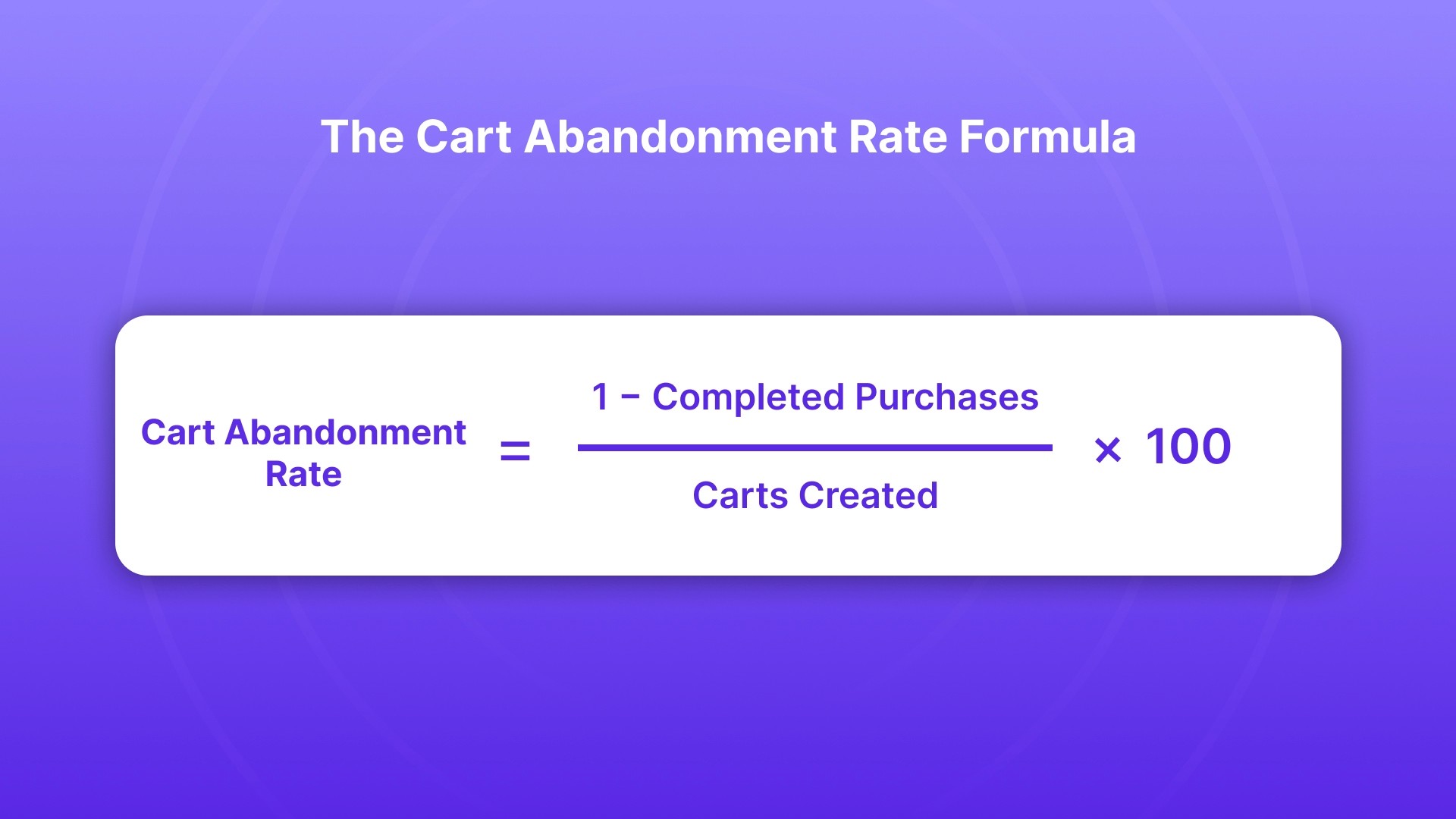
The cart abandonment rate formula gives you a clear picture of how many shoppers start the buying process but leave before completing it. It is the foundation for diagnosing leaks in your funnel and measuring how effective your checkout experience truly is.
Cart Abandonment Rate = (1 − Completed Purchases ÷ Carts Created) × 100
For example, if your ecommerce store generated 1,000 shopping carts in a month and 250 of them turned into completed purchases, the calculation would be:
(1 − 250 ÷ 1,000) × 100 = 75%
This means 75% of your shoppers abandoned their carts, leaving only one in four to complete a purchase, a strong indicator that something in your post-click experience needs attention.
However, accuracy depends on what your analytics platform defines as a "cart." For instance, Shopify typically counts an "add to cart" action, whereas GA4 might track the "begin checkout" event. This small difference can lead to significantly varied results.
Pro Tip: Define your "cart creation" event once and track it consistently across all reports. Whether you choose "add to cart" or "begin checkout," using a consistent metric gives you reliable trend data and helps you spot meaningful improvements over time.
Understanding the formula is the starting point; the next step is learning how to calculate it accurately and analyze the results for better decision-making.
How to Calculate Cart Abandonment Rate (Step-by-Step)
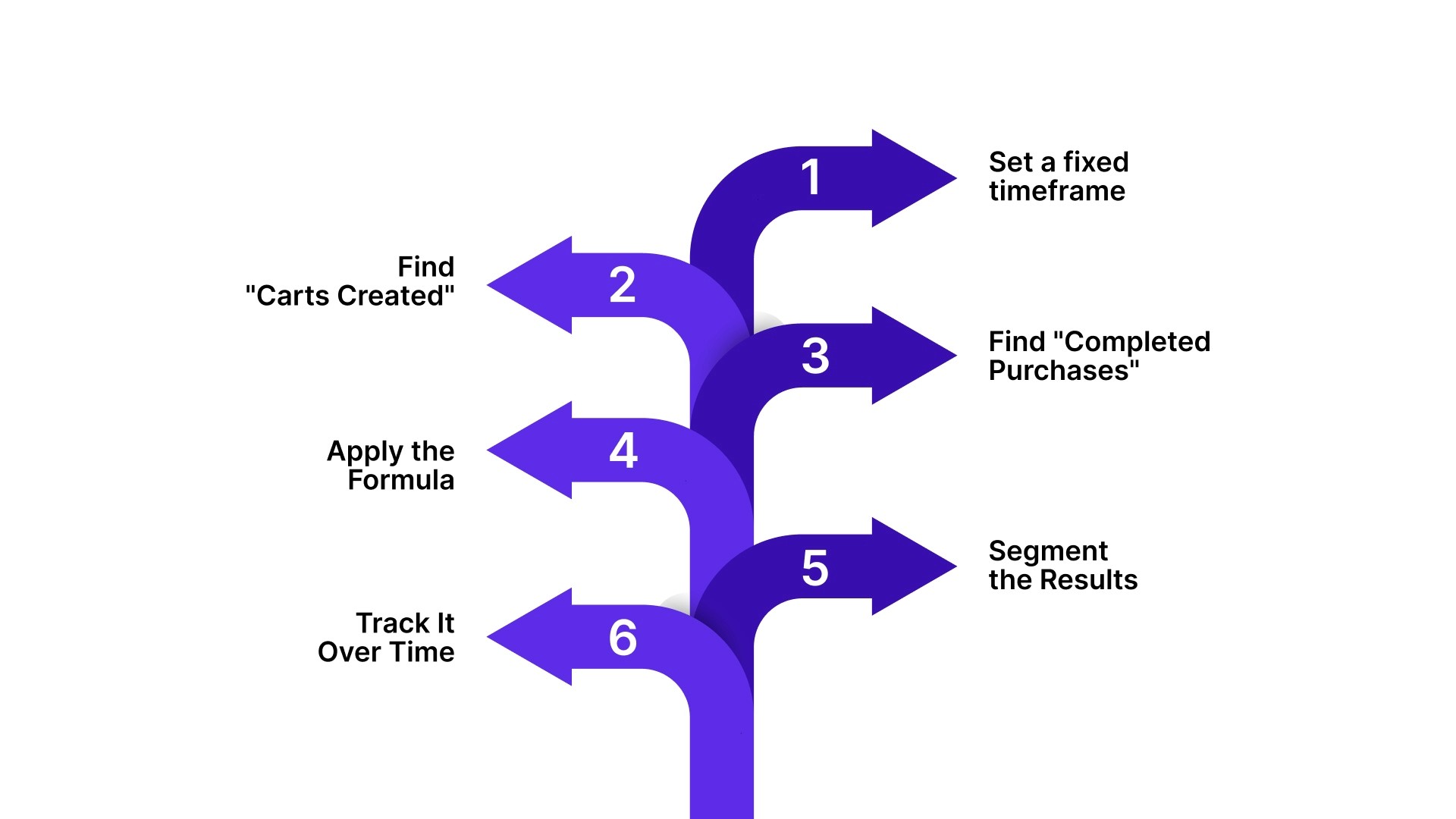
To make this metric useful, you need a process that connects data from your ecommerce platform with real business insights.
Here's how you can calculate your cart abandonment rate accurately:
Step 1: Set a fixed timeframe:
Pick a specific window, for example, the last 30 days or your latest ad campaign period. Keeping the timeframe consistent helps you compare performance over time.
Step 2: Find "Carts Created":
In Shopify or WooCommerce, check your analytics dashboard for total "Add to Cart" events. In GA4, use the "Begin Checkout" metric if that better reflects intent.
Step 3: Find "Completed Purchases":
Note the number of successful orders placed in the same timeframe. Ensure you're pulling both metrics from the same data source to avoid inconsistencies.
Step 4: Apply the Formula:
Use this:
Cart Abandonment Rate = (1 − Completed Purchases ÷ Carts Created) × 100
If you had 1,000 carts and 250 completed purchases, your rate is 75%.
Step 5: Segment the Results:
Break down your abandonment rate by traffic source, device, and region. For example, TikTok traffic might have a 10% higher drop-off than email traffic, showing you where to optimize first.
Step 6: Track It Over Time:
Create a simple dashboard to monitor weekly or monthly trends. Spikes could point to a checkout bug, pricing change, or poor mobile experience.
Pro Tip: Combine this rate with your Average Order Value (AOV) to estimate how much revenue you lose each month due to abandonment. It's the most practical way to quantify the impact.
Once you know how to calculate it correctly, the next step is understanding how your rate compares to others; that's where industry benchmarks come in.
Cart Abandonment Benchmarks by Industry
Understanding cart abandonment rates across various industries helps you evaluate how your ecommerce store stacks up. These benchmarks offer insights into typical drop-off rates, helping you set realistic goals for your business:
Industry | Cart Abandonment Rate | Reasons for Abandonment |
|---|---|---|
Retail & E-commerce | ~70-75% | Averages are often high due to the competitive nature of the industry and multiple decision points. |
Travel & Airlines | ~85-90% | High due to research-intensive buying behavior, where users often abandon carts after checking flights or booking details. |
Fashion & Apparel | ~75% | Impulse shopping and frequent returns contribute to significant abandonment in this sector. |
Luxury Goods | ~80% | Higher abandonment is driven by comparison shopping and longer purchase decision cycles for high-ticket items. |
Electronics | ~68-72% | Customers often browse for specific product features and prices before making a final decision. |
Financial Services | ~83% | Abandonment is higher due to complex forms and lengthy application processes. |
Subscription Services | ~75% | Subscription-based models experience abandonment as customers hesitate before committing to recurring payments. |
These benchmarks give you a rough idea of where you stand, but each store is unique. In the next section, let's look into the common causes of cart abandonment and how to address them effectively.
Common Reasons for Cart Abandonment
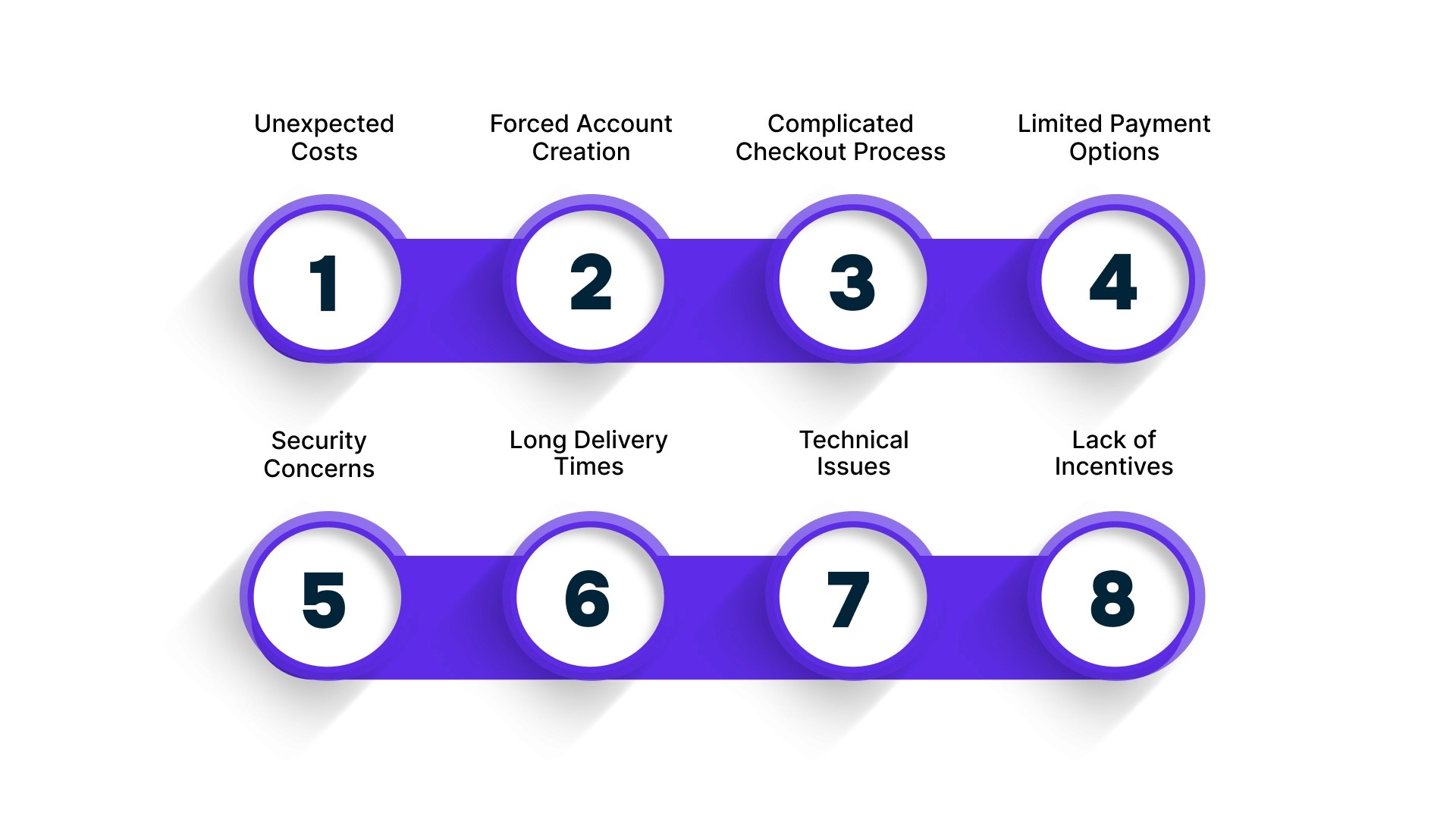
Cart abandonment happens for many reasons, but most of them come down to friction in the shopping experience. Whether it's unexpected costs or a complicated checkout process, understanding these reasons is the first step to reducing drop-offs.
Here are the most common reasons why customers abandon their carts:
Unexpected Costs: Extra fees for shipping, taxes, or handling that appear at checkout are often a dealbreaker.
Forced Account Creation: Many shoppers abandon when asked to create an account instead of checking out as guests.
Complicated Checkout Process: Too many form fields, slow-loading pages, or unclear instructions can make customers leave before completing the purchase.
Limited Payment Options: Not offering the payment methods customers prefer, like PayPal or Apple Pay, can cause them to abandon their carts.
Security Concerns: If a site seems untrustworthy or lacks visible security badges, customers will hesitate to finalize their purchase.
Slow Shipping or Long Delivery Times: Shoppers may leave if shipping options are too slow or expensive.
Technical Issues: Glitches like broken links, missing images, or a non-responsive mobile experience can frustrate customers and cause them to abandon the cart.
Lack of Incentives: Without discounts, free shipping, or other incentives, customers may abandon carts, especially when comparing prices.
Is there a way to stop shoppers from leaving their carts unfinished?
Nudge helps you do that by triggering personalized prompts at the perfect moment, when users pause, scroll away, or show exit intent. These timely nudges re-engage shoppers and encourage them to complete their purchase seamlessly.

By addressing these issues, you can reduce cart abandonment and increase conversions. Let's now explore some effective strategies to reduce cart abandonment and turn those missed opportunities into successful sales.
How to Reduce Cart Abandonment (Actionable Strategies)
Reducing cart abandonment requires optimizing every touchpoint between intent and purchase. The goal is to eliminate friction, build trust, and nudge users to complete checkout faster.
The following strategies are practical steps you can apply immediately to lower your abandonment rate and recover lost revenue:
Simplify the Checkout Process: Shorten the number of steps between the cart and payment. Use progress indicators, autofill fields, and offer guest checkout to make the process quick and frustration-free.
Display Total Cost Upfront: Be transparent with shipping fees, taxes, and discounts before checkout. Unexpected costs are the top reason shoppers leave. Clarity builds trust and reduces hesitation.
Offer Flexible Payment Options: Integrate popular wallets like PayPal, Apple Pay, and Buy Now, Pay Later options. Convenience during payment directly increases completion rates, especially on mobile.
Use Exit-Intent and Reminder Nudges: Trigger personalized pop-ups or offers when users show intent to leave. A free shipping reminder or limited-time discount can recover an otherwise lost sale.
Personalize the Experience: Show product recommendations, location-based offers, or cart reminders personalized to user behavior. Context-aware personalization ensures every shopper sees something relevant and timely.
Nudge improves these strategies by lifting AOV and conversions through adaptive product recommendations. Its AI dynamically adjusts offers, bundles, and layouts in real time, ensuring every shopper sees the most relevant products and incentives to complete their purchase.
Also Read: 10 Proven Tips for Increasing Add to Cart Conversion Rates
When personalization works seamlessly with user intent, it not only reduces abandonment but also increases conversions. That brings us to the next section, Can AI Personalization Reduce Cart Abandonment?
Can AI Personalization Reduce Cart Abandonment?
AI personalization helps reduce cart abandonment by adapting the shopping experience in real time. Instead of showing the same static pages to every visitor, AI personalizes content, offers, and layouts based on each shopper's intent, device, and journey stage.
That is exactly what Nudge enables for modern ecommerce brands. It acts as an autonomous experience layer that replaces static funnels with personalized, AI-driven journeys, built dynamically for every shopper and optimized continuously for higher conversions. In short, Nudge turns every session into a personalized storefront that adapts instantly to user behavior.
Here's how Nudge helps you reduce cart abandonment and increase conversions:
Real-Time Personalization Across the Funnel: Nudge adapts homepages, product pages, carts, and checkouts instantly based on each shopper's behavior, campaign source, and buying intent, ensuring relevance at every step.
AI Product Recommendations: Display context-aware suggestions and smart bundles that update dynamically with inventory and browsing activity, increasing both AOV and completion rates.
Contextual Nudges: Trigger timely banners, pop-ups, or modals when users show exit intent, scroll beyond a certain depth, or spend too long on a page, converting hesitation into action.
Cart Abandonment Recovery: Automatically send personalized offers or reminders to shoppers who left their carts behind, re-engaging them without manual follow-ups.
No Developer Bottlenecks: Launch and test new experiences without writing code. Marketers can iterate instantly, reducing turnaround time from weeks to minutes.
By combining real-time context, behavior-driven personalization, and AI-powered adaptability, Nudge helps you turn abandoned carts into completed checkouts, improving conversion rates, average order value, and overall marketing ROI.

Wrapping Up
Understanding and applying the cart abandonment rate formula helps you identify where shoppers drop off and what changes can recover lost revenue. Reducing abandonment is one of the fastest ways to improve conversions without increasing ad spend.
With Nudge, you can deliver personalized, real-time experiences that adapt to every shopper's behavior and intent, turning abandoned carts into completed purchases.
Book a demo today to see how Nudge can help you capture more sales effortlessly.
FAQs
1. How often should you measure your cart abandonment rate?
It's best to calculate it weekly or monthly, depending on traffic volume. Frequent tracking helps you spot arising checkout issues or campaign-specific trends before they impact sales.
2. What is considered a high cart abandonment rate?
Anything above 75% generally signals friction in the checkout process, unclear pricing, or weak incentives. However, context matters; compare your rate against your own past data and industry benchmarks.
3. Can optimizing product pages help reduce cart abandonment?
Yes. Clear product descriptions, visible shipping details, and social proof like reviews or "low stock" indicators reassure customers and increase their confidence to buy.
4. Do discount codes always help recover abandoned carts?
Not always. While limited-time offers can nudge indecisive buyers, overusing discounts can erode perceived value. Balance them with transparency and better UX for lasting improvement.
5. How does Nudge help prevent cart abandonment?
Nudge uses AI personalization to adapt landing pages, carts, and checkouts in real time. It shows relevant products, contextual nudges, and timely reminders that reduce drop-offs and increase conversions.