User Engagement
What is DAU? A Complete Guide to Daily Active Users in 2025
Understand what Daily Active Users (DAU) means, how to measure it effectively, and discover strategies to boost user engagement and retention in ecommerce.

Kanishka Thakur






Many ecommerce marketers spend heavily on paid traffic but often see a discouraging pattern. Visitors click through once, browse briefly, and rarely return. The result is low engagement and stagnant growth despite rising acquisition costs. This creates a bigger question: are shoppers finding real value after the first visit, or is your funnel losing their attention right after the click?
That’s where Daily Active Users (DAU) becomes a critical measure of product and experience health. DAU tracks how many unique users actively engage with your site or app within a 24-hour window. It goes beyond surface metrics like visits or downloads to show how many shoppers consistently return and interact, giving you a live pulse on retention and engagement quality.
This article breaks down what DAU really measures, how ecommerce and digital brands track it, and why understanding this metric is key to improving retention and long-term growth in 2025.
Overview
Discover what DAU means, how it tracks daily active users, and why it’s a critical metric for measuring ecommerce engagement and platform growth.
Learn how to calculate DAU accurately across platforms, track unique users, and interpret daily engagement trends to improve retention outcomes.
Understand DAU/MAU ratios, what they reveal about user stickiness, and how strong engagement signals indicate lasting customer relationships.
Explore DAU’s limitations, how to pair it with deeper behavioral metrics, and why a balanced analytics view matters for long-term success.
See how Nudge helps ecommerce brands boost DAU through real-time personalization, dynamic experiences, and relevant customer interactions.
Why is DAU Important for Ecommerce and DTC Brands?
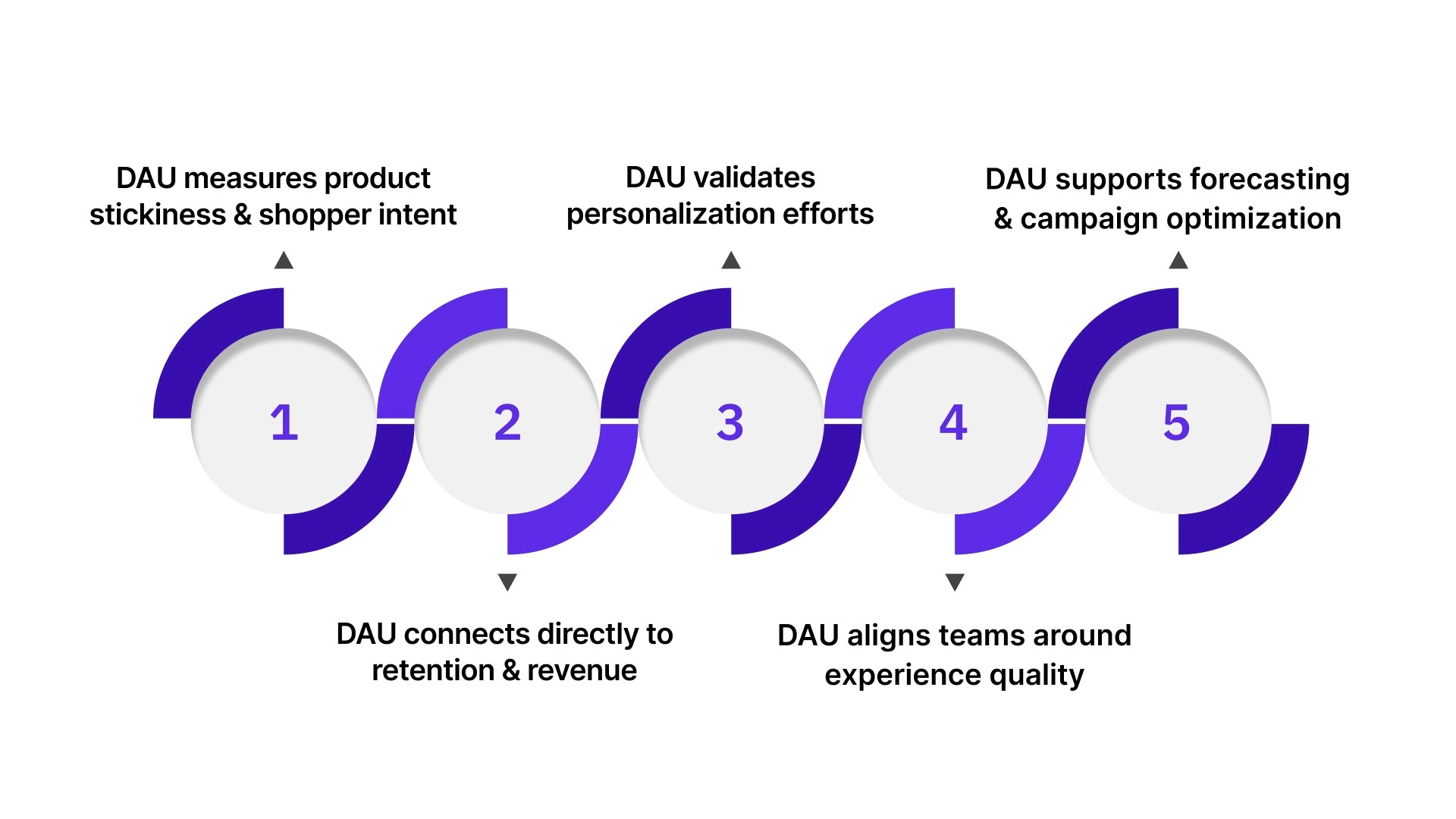
According to a 2025 report on DTC subscription brands, the global subscription economy reached $492 billion in 2024 and is projected to hit $1.5 trillion by 2033. In this market, Daily Active Users (DAU) is a crucial metric as only 20% of subscription businesses improve customer retention, underscoring the importance of daily engagement metrics like DAU for growth.
For ecommerce and direct-to-consumer (DTC) brands in 2025, DAU reflects how effectively the brand converts paid traffic into repeat, high-intent visitors, which is the foundation of sustainable growth. When customer acquisition costs are rising and ad channels are increasingly saturated, a strong DAU trend is often the clearest signal that your product experience is doing its job.
1. Shows Whether Shoppers Find Real Value Daily
A growing DAU trend means users are returning on their own and engaging with your product pages, offers, content, or personalized experiences. When DAU declines, it typically signals issues with relevance, friction in the journey, or an experience that isn’t giving shoppers a strong reason to return.
2. Connects Directly to Retention and Revenue
Brands with steady daily activity usually maintain stronger repeat purchase rates and healthier customer lifetime value. A good DAU-to-MAU ratio indicates that a meaningful share of monthly users keep coming back, reducing the pressure on acquisition and discount-heavy campaigns.
3. Helps Validate Personalization and Experience Changes
Since DAU refreshes every 24 hours, it acts as a fast feedback loop. If DAU increases after introducing new recommendations, landing pages, or personalized elements, it is a strong sign that those changes are resonating. This is much quicker than waiting for slower indicators like lifetime value or long-term cohort data.
4. Aligns Teams Around Experience Quality, Not Traffic Volume
High-growth ecommerce brands are prioritizing experience quality over acquisition scale. DAU keeps marketers, UX specialists, and growth managers focused on creating reasons for customers to return daily.
It does this through dynamic homepages, relevant bundles, and personalized incentives rather than chasing one-time clicks.
5. DAU Supports Forecasting and Campaign Optimization
Consistent daily activity creates more predictable revenue patterns. A sudden drop in DAU can indicate issues with site performance, inventory, creative alignment, or user experience. When tracked well, DAU becomes an early warning signal for possible engagement and conversion problems.
In short: The brands that win are the ones that keep shoppers coming back every day through relevant, adaptive experiences that feel fresh on every visit.
Also Read: Top 10 E-Commerce Personalization Tools to Increase Conversions (2025)

How to Calculate DAU for Ecommerce and DTC Brands?
DAU reflects how many unique users meaningfully interact with your storefront within a 24-hour period. For ecommerce and DTC brands, this can include browsing products, viewing collections, adding items to cart, engaging with personalized offers, or completing a purchase. The goal is to measure real engagement rather than surface-level traffic.
To make DAU a useful metric, it must be calculated with precision. Counting every visit can inflate engagement, while counting only purchases can hide important intent signals. Below is a clear process to calculate DAU accurately and ensure the metric reflects true daily interaction.
1. Define What “Active” Means for Your Business
Before you calculate anything, set clear criteria for what counts as an active user. In ecommerce, this typically includes value-driven interactions such as:
Viewing a product detail page or collection page
Adding items to the cart or wishlist
Starting checkout
Redeeming or interacting with a personalized offer
Responding to a contextual nudge or on-site prompt
Engaging with quizzes, shoppable videos, or guided recommendations
These actions show intent and actual interest. They are stronger signals than passive browsing.
2. Count Unique Users Within a 24-Hour Period
DAU tracks the number of individual users who perform at least one qualifying action in a single day.
A user who returns multiple times within one day still counts as one
Tools like GA4, Mixpanel, and Amplitude automatically deduplicate users
Logged-in users are tracked through user ID, while anonymous users are measured via device or cookie-based identifiers
This ensures that DAU reflects the size of your genuinely engaged audience
3. Track Rolling Averages for Clearer Insights
Single-day DAU often fluctuates due to promotions, pay cycles, holidays, or campaign bursts. Growth teams use rolling averages to identify meaningful trends.
A 7-day rolling average smooths short-term volatility
A 30-day rolling average reveals medium-term engagement patterns
Tracking both helps distinguish temporary spikes from sustained improvements.
4. Segment Your DAU for Deeper Clarity
A single DAU number cannot show which users are driving engagement. Segmenting brings visibility into user intent and quality.
Useful segmentation categories include:
Traffic sources such as Meta, TikTok, email, or organic
New visitors versus returning customers
Device type, such as mobile, desktop, or tablet
Geography or region
Funnel stag,e such as discovery, consideration, or repeat purchase behavior
This breakdown helps identify which channels and cohorts contribute most to healthy daily activity.
5. Pair DAU With Complementary Metrics
DAU becomes far more meaningful when viewed alongside other engagement and revenue indicators.
Track DAU together with:
MAU to calculate the DAU to MAU ratio, a key signal of stickiness
Conversion rate to see whether daily sessions turn into revenue
AOV and LTV to understand how daily engagement influences long-term value
Session depth, PDP views, and time on site for engagement quality
For example, if you have 12,000 daily active users and 90,000 monthly active users, your DAU to MAU ratio is about 13 percent. Many high-performing ecommerce categories aim for 15 to 20 percent, depending on purchase frequency and user habits.
Understanding the DAU/MAU Ratio
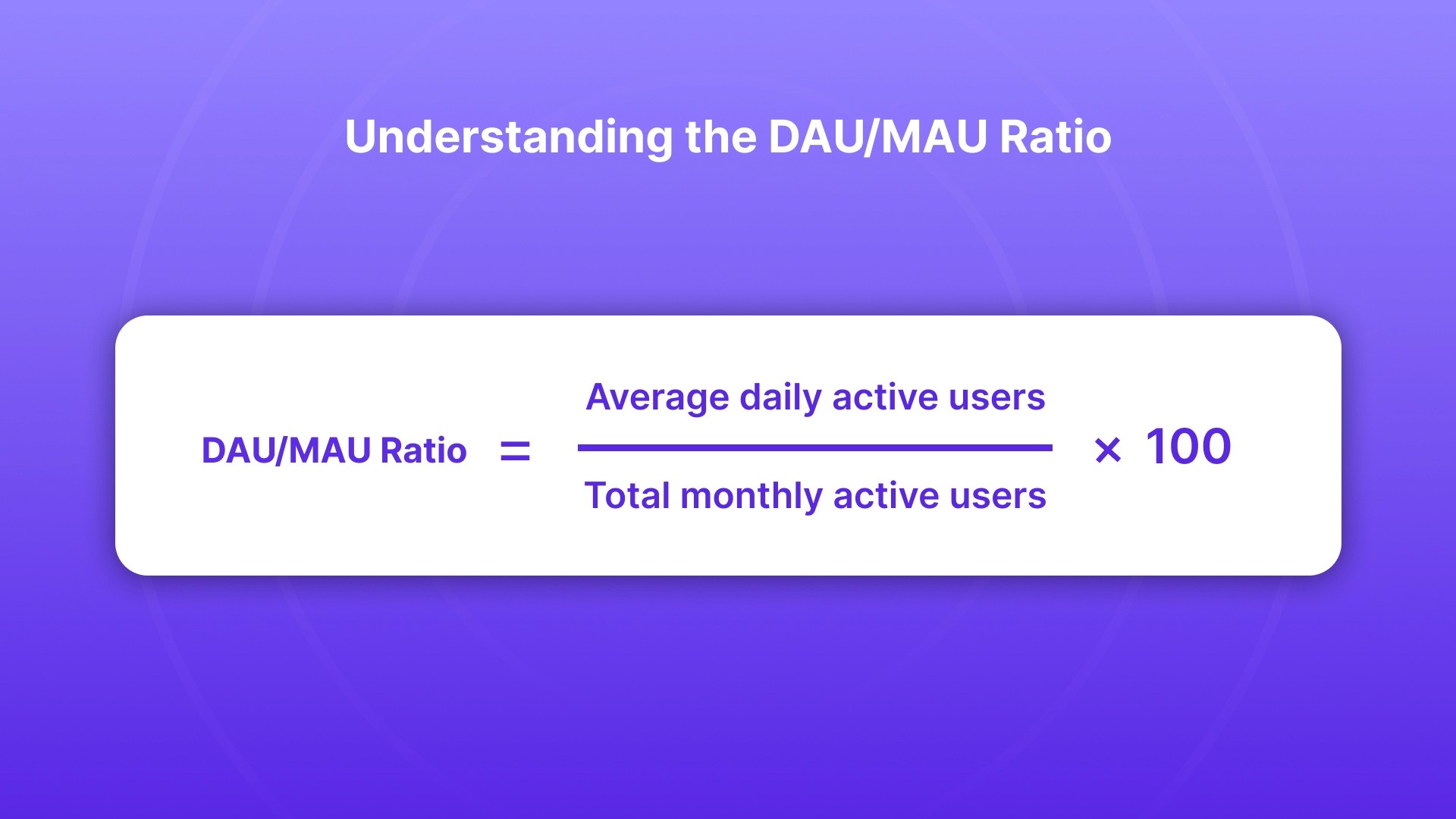
While DAU tells you how many shoppers engage with your brand daily, it doesn’t reveal how sticky that engagement is. That’s where the DAU/MAU ratio comes in, a simple yet powerful way to measure how consistently customers return to your store over time.
The DAU/MAU ratio is calculated by dividing your average daily active users by your total monthly active users and expressing it as a percentage:

This ratio shows the proportion of monthly visitors who are active on a typical day, or essentially, how “habit-forming” your experience is.
What a good DAU/MAU ratio looks like for ecommerce and DTC:
10–15%: Healthy for most mid-frequency categories like fashion, beauty, and home goods.
15–25%: Strong for high-engagement verticals like grocery, delivery, or wellness subscriptions.
Below 10%: Often signals weak daily engagement or heavy reliance on one-time campaigns.
Why it matters: For ecommerce marketers and growth managers, the DAU/MAU ratio ties daily engagement to retention health. A rising ratio means shoppers aren’t just clicking through ads, they’re forming habits around your storefront, content, or offers.
A falling ratio, on the other hand, often points to surface-level engagement that doesn’t translate to repeat traffic or purchases.
When paired with metrics like conversion rate (CVR), Average Order Value (AOV), and Lifetime Value (LTV), the DAU/MAU ratio helps teams see whether their personalization and post-click experiences are building sustained value.
Also Read: How to Increase Conversion Rate: 8 Tactics for 2024

The Limits of DAU: How Smart Brands Move Beyond Them
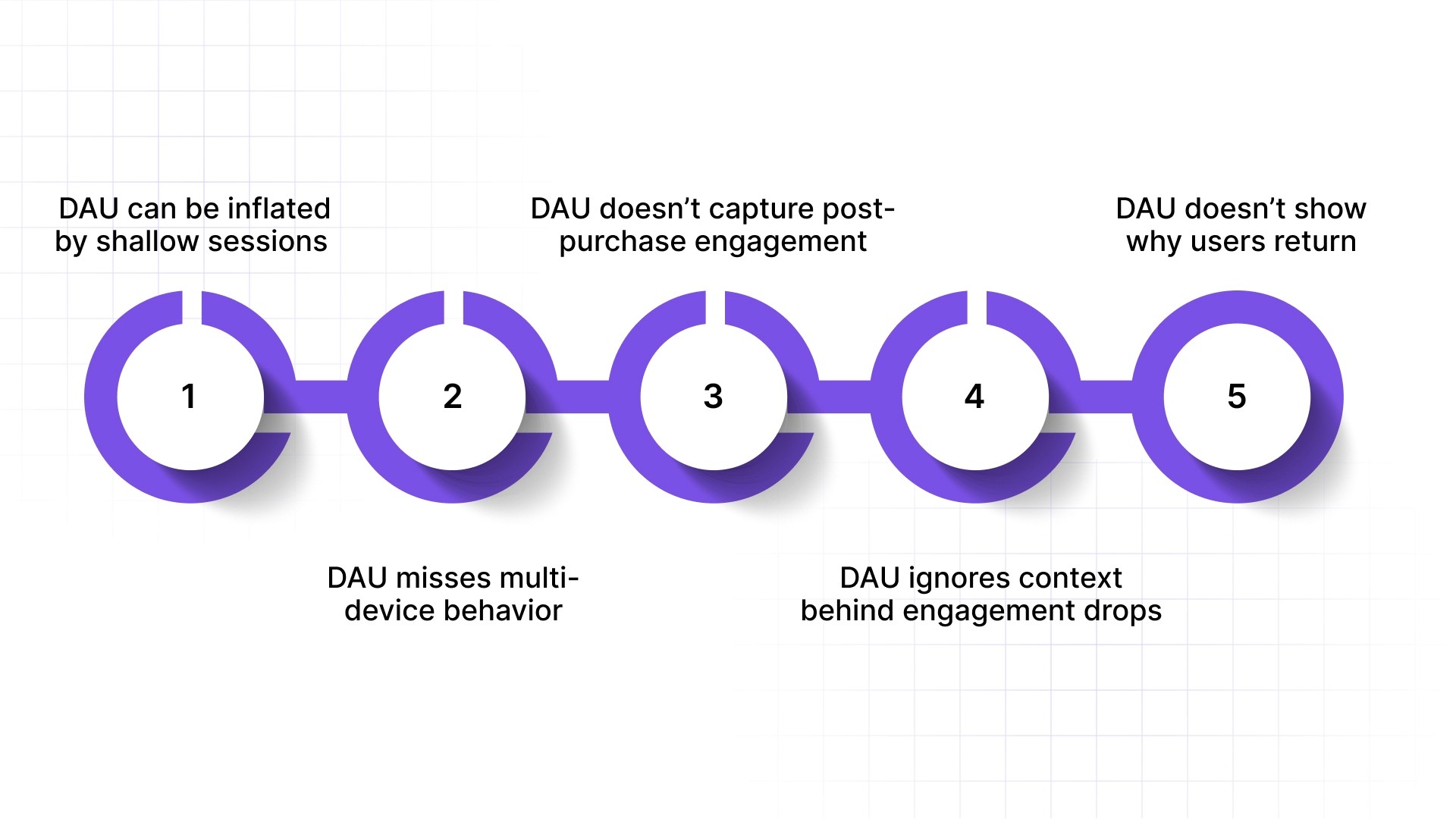
DAU gives a quick pulse on how many people interact with your storefront daily, but it doesn’t always capture the quality of that engagement. For ecommerce and DTC brands, especially those spending heavily on paid traffic, DAU can look strong on paper while masking deeper experience or retention issues.
Here are some common limitations and tips to overcome them:
1. DAU can be inflated by shallow sessions: Not every visit equals meaningful engagement. Paid campaigns, influencer drops, or flash sales can create traffic spikes that temporarily lift DAU but don’t reflect lasting interest. A shopper who clicks an ad, scrolls, and exits in seconds still counts as “active.”
Solution: Pair DAU with session depth metrics like time on site, PDP views, or engagement with contextual nudges. This filters vanity traffic from shoppers genuinely exploring or purchasing.
2. DAU misses multi-device behavior: Modern shoppers move fluidly between devices, whether it is browsing on mobile, checking details on desktop, and completing purchases later. Traditional DAU tracking often treats each device as a separate user, undercounting true engagement.
Solution: Adopt cross-device identity resolution through unified customer IDs or authenticated sessions. Many modern platforms help marketers consolidate these signals into a single view of the shopper journey.
3. DAU doesn’t capture post-purchase engagement: A customer who buys once but never returns may look “active” during checkout but provides little long-term value. DAU on its own can’t distinguish one-time buyers from repeat loyalists.
Solution: Track DAU alongside retention metrics like repeat purchase rate, cohort activity, and LTV. This can help reveal which engagement patterns lead to repeat sessions within 7, 14, or 30 days.
4. DAU ignores context behind engagement drops: Seasonal cycles, inventory gaps, or outdated creative can cause natural dips in daily engagement. Looking at DAU in isolation might mislead teams into reacting to short-term noise instead of diagnosing structural issues.
Solution: Use DAU trend baselines and layer them with campaign, category, or UX data. This helps isolate what’s driving real change, whether a slow load time, an unoptimized offer, or creative fatigue.
5. DAU doesn’t show why users return: Even strong DAU growth can mask the underlying reason shoppers are returning, whether it is discounts, habit, or a genuinely relevant experience.
Solution: Integrate qualitative feedback loops such as on-site surveys, NPS scores, or AI-driven journey analysis. Combining behavioral data with shopper intent signals gives a richer picture of what’s working and what’s not.
Even though DAU is a foundational metric, it's only powerful when seen in context. The real growth advantage comes from linking daily engagement to depth, retention, and personalization quality.
Also Read: What Are Customer Touch Points? {Examples Inc}
How Can Ecommerce and DTC Brands Improve DAU? Best Practices

Improving DAU is not only about driving more traffic. It requires creating consistent reasons for shoppers to return and interact with your storefront every day. Strong DAU comes from experiences that feel relevant, fast, adaptive, and rewarding. The goal is to turn each session into a moment of value that encourages shoppers to come back again.
Here are the best practices that help ecommerce and DTC brands strengthen daily engagement.
1. Personalize Every Session in Real Time
Shoppers return more often when each visit feels tailored to their interests. Real-time personalization helps surface the most relevant products, categories, and offers based on browsing history, intent, and traffic source.
Examples include:
PDP and PLP layouts that highlight items similar to past views
Product grids that refresh based on user behavior
Personalized bundles or complementary suggestions
Contextual nudges triggered based on referrer, location, or time on site
When each visit feels different and relevant, daily engagement becomes more consistent.
2. Reduce Friction From Discovery to Purchase
Even small usability issues can prevent users from returning regularly. A smoother experience encourages shoppers to browse more frequently.
Areas to optimize include:
Page load times
Search relevance and filtering
Navigation clarity across mobile and desktop
Reducing repetitive steps during browsing or checkout
Updating outdated layouts or content sequences
When the path from interest to action is short and intuitive, users re-engage more often.
3. Turn Campaign Traffic Into Ongoing Engagement
Most brands see temporary DAU spikes during paid campaigns. The key is converting those campaign visitors into recurring active users.
Effective approaches include:
Routing paid traffic to landing pages aligned with the ad’s creative
Showing personalized recommendations linked to the viewed product or category
Retargeting users with reminders about items they discovered earlier
Encouraging return visits through saved carts, lookbooks, or recently viewed items
These tactics help transform campaign bursts into sustained daily activity.
4. Introduce Low-Friction Micro-Engagements
Small, frequent touchpoints strengthen user habits. Micro-engagements invite shoppers to interact even when they are not ready to buy.
Examples include:
Daily drops, new arrival previews, or limited-time collections
Interactive features such as style guides, quizzes, or shoppable videos
Progress-based incentives or loyalty milestones
Personalized lookbooks or curated edits
Micro-engagements deepen familiarity and help increase the DAU to MAU ratio over time.
Use Real-Time Data to Iterate Faster
DAU improves when marketing teams can learn and adapt quickly. Fast iteration ensures the storefront stays relevant, updated, and aligned with user behavior.
Helpful tactics include:
Monitoring daily session data, heatmaps, and engagement depth
Running real-time experiments on page layouts or product grids
Using behavioral insights to refine landing pages and homepage elements
Updating offers or recommendations based on inventory and demand patterns
Frequent iteration helps keep the experience fresh, which directly contributes to stronger daily activity.
Sustained growth in DAU doesn’t come from pushing more traffic into the funnel. It comes from designing experiences that feel continuously alive, where every session reflects real-time intent and gives shoppers a reason to return tomorrow.
That’s exactly where adaptive experience layers like Nudge create measurable differentiation for modern ecommerce brands.
Also Read: Best Product Recommendation Systems For Online Stores

How Nudge Empowers Ecommerce Marketers to Improve DAU
Driving consistent DAU requires delivering personalized, habit-forming experiences that keep shoppers engaged every day. High-growth ecommerce and DTC brands often struggle with low repeat visits, post-click drop-offs, and static content that fails to reflect real-time shopper intent.
Nudge helps marketers overcome these challenges by automating real-time personalization, contextual engagement, and adaptive content delivery across the funnel, increasing DAU, conversion rates, and customer lifetime value while reducing dependency on engineering teams.
Below are the key ways Nudge empowers marketers:
Real-time personalization across the funnel: Nudge adapts homepages, PDPs, PLPs, carts, and checkout flows in real time based on each visitor’s behavior and source. Fashion and beauty brands show fresh products daily, while grocery and delivery brands surface restocks and limited-time offers that drive repeat visits.
Contextual nudges that re-engage shoppers: Nudge triggers targeted banners and pop-ups using signals like exit intent or time-on-page. Subscription and wellness brands highlight restocks or new drops, while lifestyle brands surface timely offers that turn casual visitors into daily shoppers.
Continuous learning and adaptation: Nudge’s AI learns from every interaction, adjusting layouts and recommendations as shopper behavior and inventory change. For fast-moving verticals like fashion or beauty, it keeps returning users engaged with fresh, relevant content.
No dev bottlenecks: Marketers can launch and test personalized experiences directly in Nudge, no code needed. Teams iterate faster on engagement hooks or offers, freeing engineering time and accelerating DAU growth.
Nudge converts daily activity into lasting loyalty. Its personalization and AI recommendations boost CVR, AOV, and LTV by keeping experiences relevant and shoppers coming back.
Book a demo with Nudge to see how real-time AI personalization can help your brand increase DAU and build customer habits that drive sustained growth.
Frequently Asked Questions
1. How should ecommerce brands define an “active” user for DAU measurement?
An active user should be defined by meaningful engagement relevant to your business goals. This could include actions like browsing products, adding items to cart, or completing a purchase. Clear criteria aligned with core value ensure DAU reflects true user activity.
2. What user actions qualify for DAU on DTC platforms?
In DTC, actions such as logging in, product browsing, adding to cart, checkout initiation, or using personalized features indicate engagement. Counting these ensures DAU captures real interaction, helping identify behaviors driving repeat visits and revenue.
3. How can DAU trends explain customer retention in ecommerce?
DAU trends reveal how frequently users return daily. A stable or growing DAU signals good retention, while declines may indicate friction or unmet needs. Monitoring this helps optimize user journeys and reduce churn by addressing pain points early.
4. Why is tracking DAU insufficient alone for business health?
While DAU measures daily engagement volume, it lacks revenue context. Pairing DAU with conversion rates, average order value, and revenue metrics creates a fuller picture of user quality and product profitability.
5. How does DAU segmentation improve marketing for ecommerce?
Segmenting DAU by demographics, behavior, or purchase frequency allows personalized marketing. Targeting active user groups with tailored offers boosts engagement, conversion, and loyalty, maximizing lifetime customer value through data-driven campaigns.
6. What challenges exist measuring DAU across devices and platforms?
Tracking unique users consistently is complex across mobile, desktop, and app interfaces. Without unified user IDs, duplicate counts or missed users skew DAU. Rigorous identity management and cross-platform analytics integration are essential for accuracy.
7. How do DAU benchmarks vary between ecommerce niches?
High frequency purchase categories (e.g., consumables) tend to have higher DAU ratios. Luxury or seasonal product sites often show lower DAU but higher value transactions. Benchmarks should be contextual, reflecting purchase cycles and user behavior typical for each niche.