Ecommerce Personalization
What Is Agentic Personalization in E-Commerce?
Discover what is agentic personalization and how it’s changing e-commerce. Learn how AI-driven experiences turn browsers into loyal customers.

Kanishka Thakur
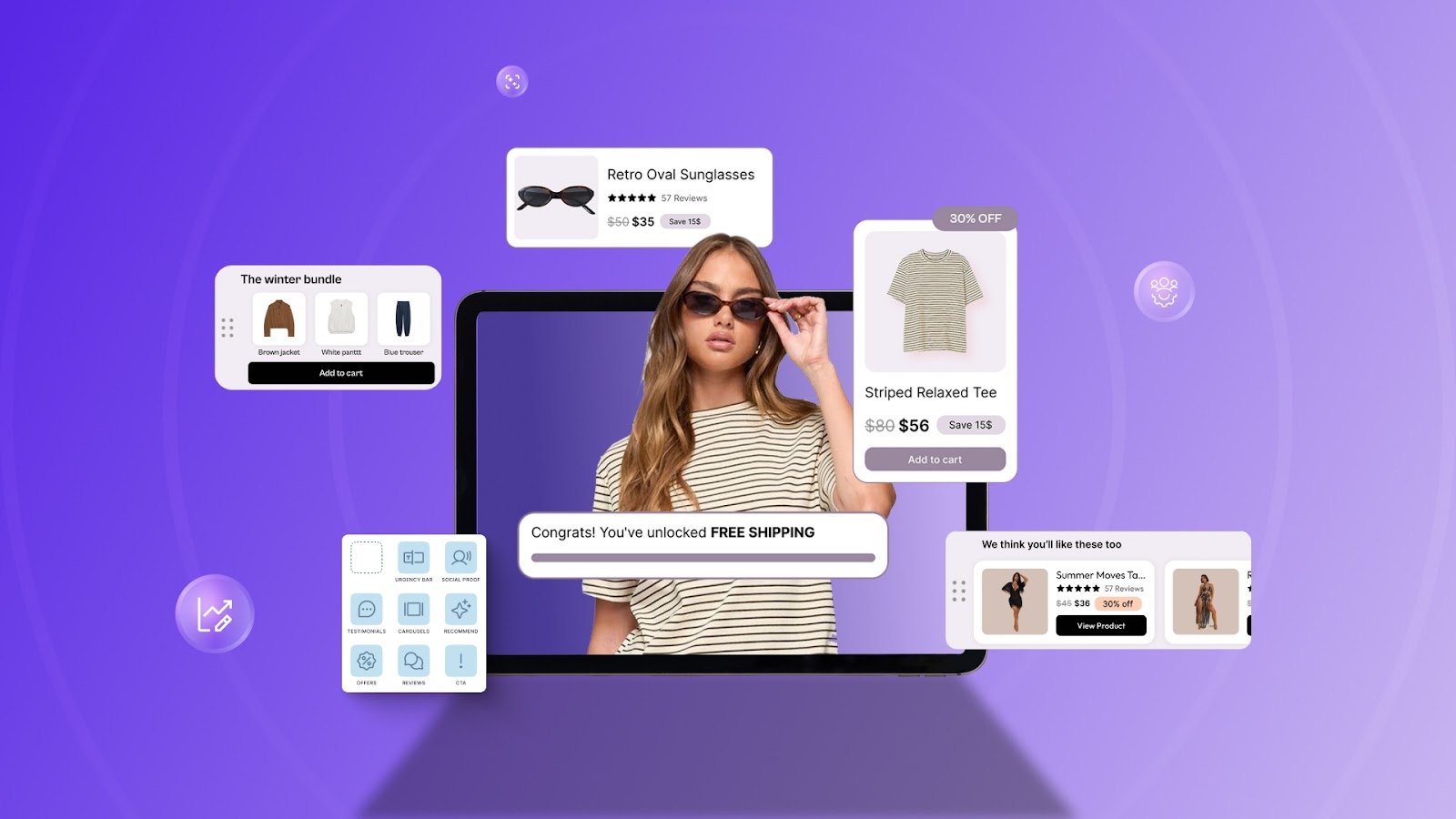





Keeping up with shopper expectations has become one of the biggest challenges for e-commerce brands. Consumers expect instant relevance, but fragmented data, manual workflows, and generic product recommendations often lead to lost sales and disengaged visitors. Even with advanced tools, personalization fatigue sets in when every brand starts feeling the same.
That’s where agentic personalization redefines the shopping experience. Powered by autonomous AI systems, it adapts every experience in real time, aligning products, content, and offers to each shopper's behavior. Gartner predicts that by 2028, 15% of daily work decisions will be made autonomously through agentic AI, signaling how quickly intelligent automation is changing commerce.
In this article, you'll learn what agentic personalization is, why it's redefining modern e-commerce, and how platforms like Nudge help brands deliver these intelligent, high-converting experiences effortlessly.
Key Takeaways
Agentic personalization uses autonomous AI agents to create adaptive, real-time shopping experiences for every user.
It replaces static, rule-based journeys with AI-driven decisions that optimize each click, layout, and product recommendation.
Modern e-commerce brands use it to improve conversions, increase AOV and LTV, and reduce customer acquisition costs.
Case studies from brands like Sephora, Amazon, and Netflix prove their measurable impact on engagement and retention.
Platforms like Nudge help marketers implement real-time personalization without coding or engineering support.
What Is Agentic Personalization?
Agentic personalization is the process of using autonomous AI agents to build individualized experiences for every user in real time, unlike traditional personalization, which relies on preset rules. Agentic systems observe, learn, and act autonomously to optimize customer journeys as they happen.
In simple terms, agentic AI doesn't wait for instructions; it makes decisions. These AI "agents" process user behavior, campaign sources, location, and even device type to modify the layout, products, and content instantly.
Think of it like a smart salesperson who understands each shopper's intent within seconds and rearranges the store shelves automatically.
Understanding how agentic personalization works is just the first step; its true impact lies in the key components that make such real-time, autonomous experiences possible.
Core Components of Agentic Personalization
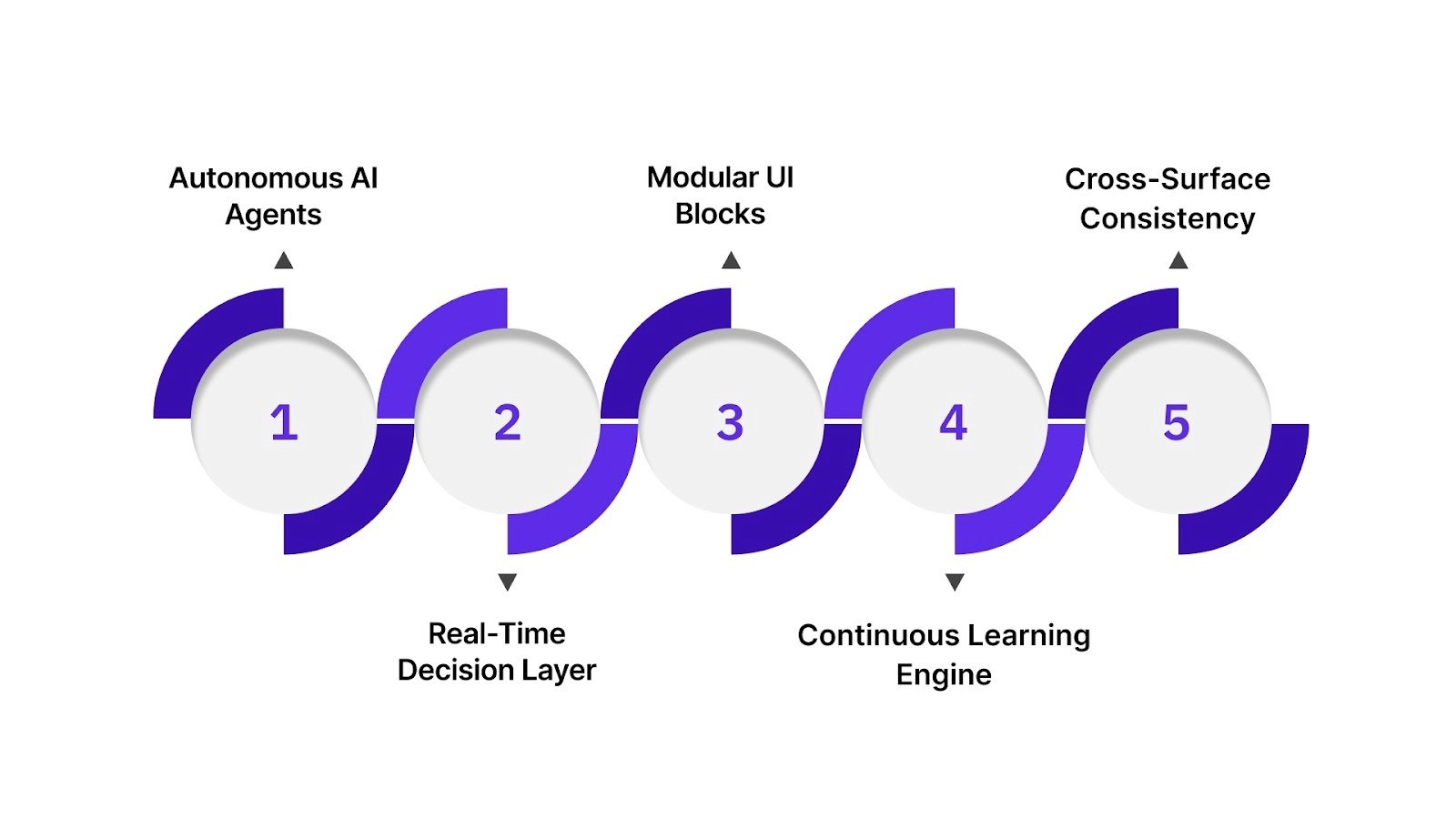
Agentic personalization works by combining intelligent systems, dynamic design elements, and real-time decision-making. Each component plays a distinct role in understanding shopper intent, adapting layouts, and optimizing engagement within milliseconds.
Core components of agentic personalization:
Autonomous AI Agents: These agents act independently to analyze context, predict shopper intent, and take real-time actions such as rearranging layouts or triggering offers without manual setup.
Real-Time Decision Layer: The decision layer processes behavioral, contextual, and transactional data simultaneously to personalize content and recommendations as the shopper interacts.
Modular UI Blocks: Dynamic components like banners, grids, and product showcases are assembled on the fly, ensuring every page layout fits each shopper's preferences and campaign source.
Continuous Learning Engine: The AI model grows with every interaction, using feedback loops to refine predictions and improve personalization accuracy over time.
Cross-Surface Consistency: From homepages to checkout, the system maintains uniform relevance, ensuring a seamless, personalized experience across all touchpoints.
How can you put these capabilities into action?
Platforms like Nudge simplify it with real-time personalization across the funnel and AI-built landing experiences that create dynamic product grids, personalized offers, and shoppable videos, all editable without code.

By understanding these foundational components, you can better appreciate the distinct advantages of agentic personalization. To highlight the differences, let's take a closer look at how agentic personalization compares to traditional methods.
Agentic Personalization vs. Traditional Personalization
Agentic personalization takes the concept of personalized experiences to the next level by incorporating real-time learning and decision-making, while traditional personalization relies on predefined rules.
Below is a comparison that highlights the key differences between these two approaches.
Attribute | Traditional Personalization | Agentic Personalization |
Autonomy | Driven by static, rule-based systems controlled by humans. | Fully autonomous, powered by AI to make decisions on the fly. |
Context | Limited to set segments or pre-determined rules. | Continuously learns and adapts in real time, based on the user's behavior. |
Integration | Often fragmented, isolated to specific channels. | Unified omnichannel delivery across all platforms, ensuring consistency. |
Learning | Requires manual configurations and limited testing. | Features continuous feedback loops, enabling self-improvement with each interaction. |
Example | Displays predefined product recommendations. | AI agents dynamically adjust product listings based on user behavior and preferences. |
By comparing these two models, it becomes evident that agentic personalization offers a far more dynamic, scalable, and seamless approach to e-commerce.
Now that you know the differences, let's look into the Benefits of Agentic Personalization and see how this approach can drive real growth for e-commerce brands.
Benefits of Agentic Personalization
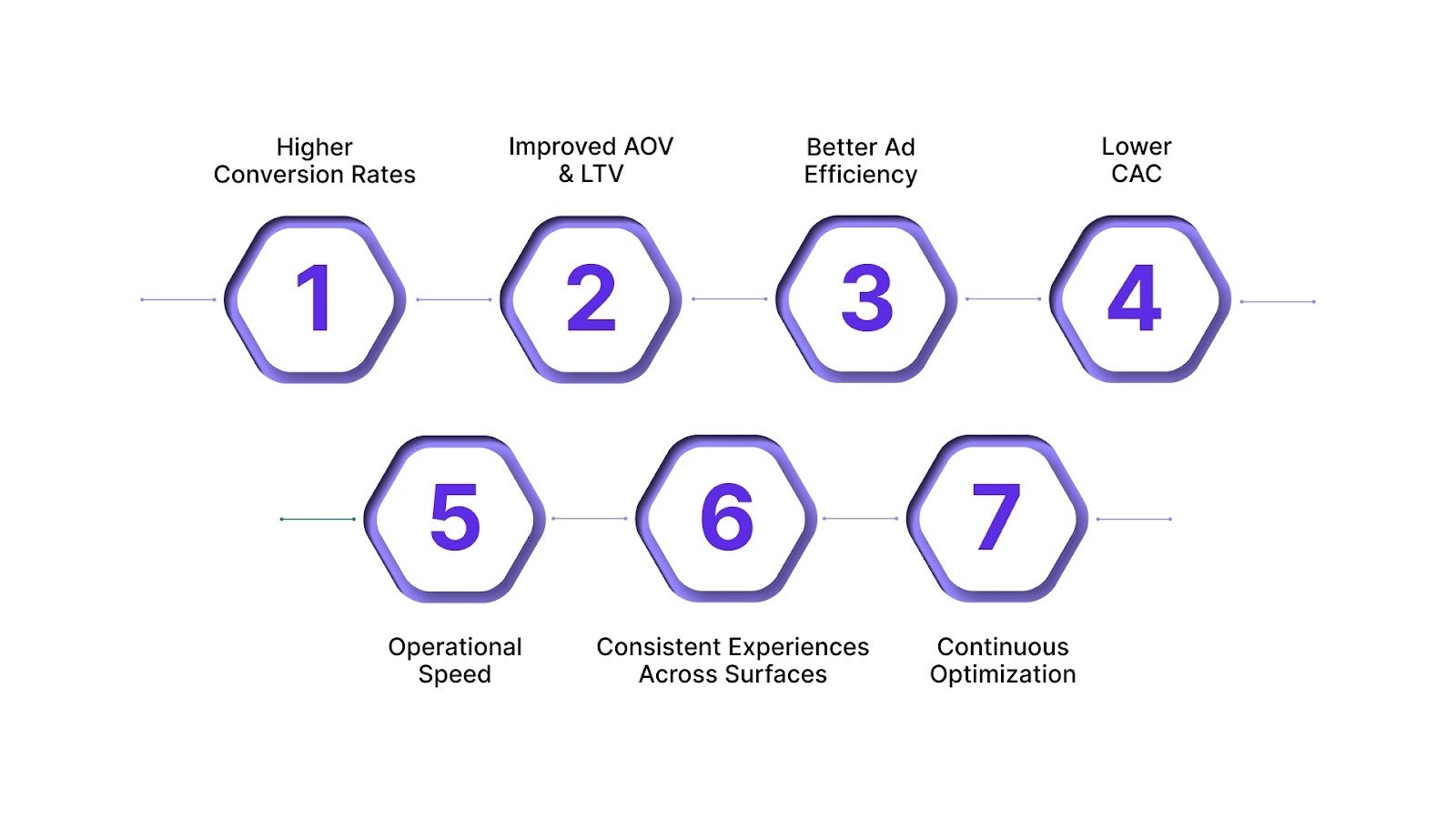
Agentic personalization delivers measurable outcomes that directly impact e-commerce growth. It combines real-time adaptability, contextual intelligence, and automation to help brands increase engagement, maximize returns, and reduce manual effort.
Key benefits for e-commerce brands:
Higher Conversion Rates: Real-time experiences respond instantly to shopper intent, reducing drop-offs and increasing checkout completions across key surfaces.
Improved AOV and LTV: Contextual cross-sells, smart bundles, and dynamically built offers drive larger order sizes and repeat purchases.
Better Ad Efficiency: Retailers using AI-powered targeted campaigns have seen a 10–25% increase in return on ad spend (ROAS, showcasing how agentic personalization can make paid traffic far more profitable.
Lower CAC: Personalized post-click journeys ensure each visitor from TikTok, Meta, or search converts faster, reducing acquisition costs over time.
Operational Speed: Marketing teams can deploy and iterate personalization campaigns without waiting for development resources.
Consistent Experiences Across Surfaces: From homepage to checkout, each surface adapts dynamically to the shopper’s journey, maintaining brand coherence and trust.
Continuous Optimization: Every session teaches the AI what works, improving relevance, layout, and timing automatically with each new interaction.
These results make agentic personalization a performance multiplier for growth-focused e-commerce brands, and understanding its implementation challenges is key to opening its full potential.
Understanding these benefits is valuable, but seeing how global brands apply agentic personalization in practice shows its real impact on engagement and growth.
How Leading Brands Use Agentic Personalization?
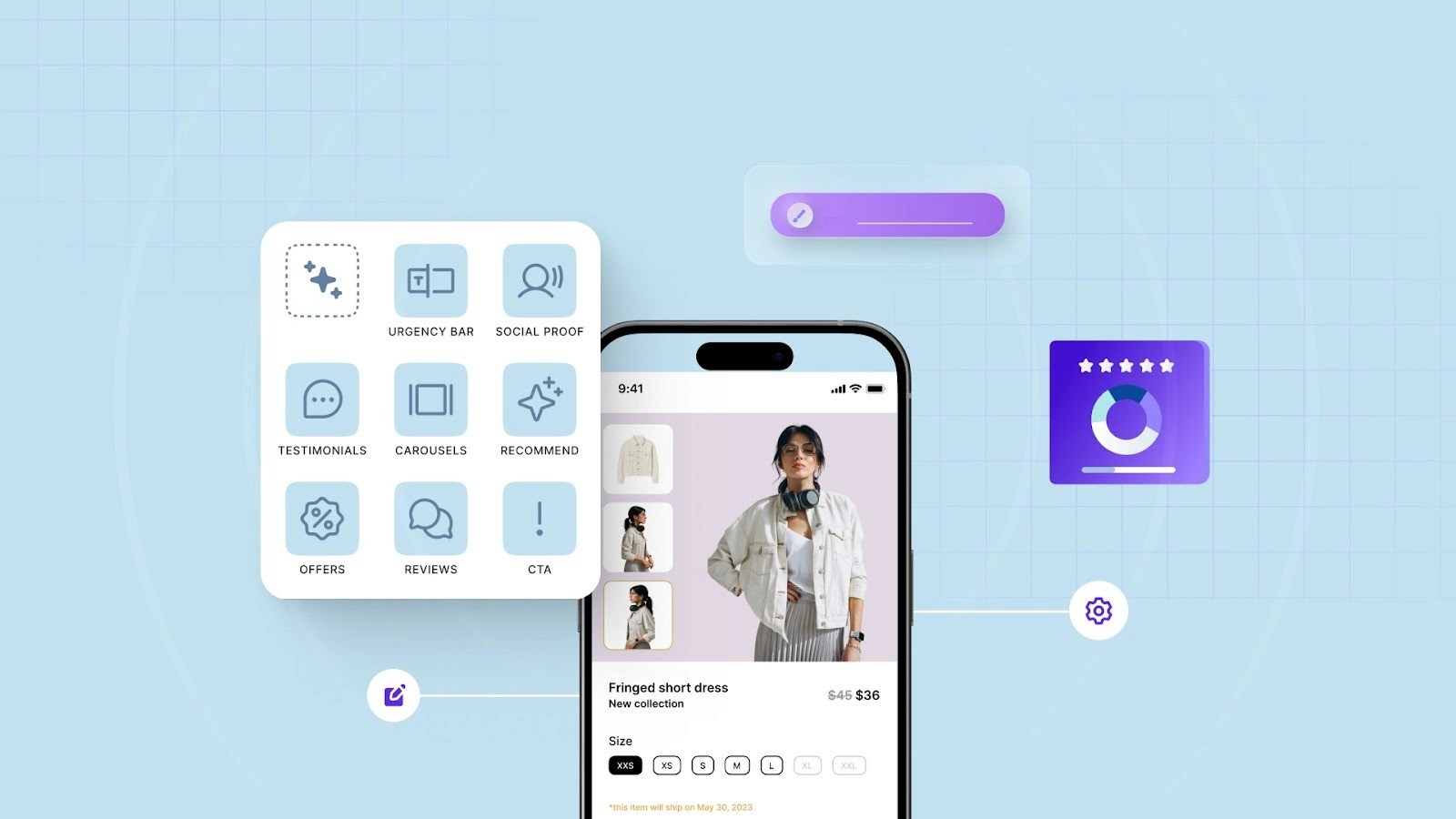
Agentic personalization is driving measurable results for global brands. From beauty to retail to entertainment, leading companies are using AI-driven experiences to increase engagement, improve conversions, and strengthen customer loyalty.
These real-world examples show how adaptable and effective this approach can be across industries.
1. Sephora
Sephora uses AI tools like its Skin Analysis and Virtual Artist inside the app and website to help shoppers scan their skin, understand concerns, and virtually try products before buying. These tools analyze factors such as tone, texture, and visible concerns in seconds to narrow down suitable products.
Personalization Focus: Based on the scan results, browsing history, and past purchases, Sephora surfaces a personalized set of product recommendations, routines, and shade matches, often adjusting suggestions in-session as users interact with different items.
Results:
Improved in-app engagement and product discovery
Higher customer satisfaction and reduced product returns
2. Amazon
Amazon uses its AI recommendation engine, part of Amazon Personalize, to analyze browsing patterns, purchase history, and product interactions in real time. The engine then serves personalized product suggestions and bundles personalized to each shopper's preferences and session context.
Personalization Focus: Recommendations dynamically adjust based on factors like viewed items, time of day, and ongoing traffic source, ensuring the right items appear at the right moment for each user.
Results:
A significant share of its overall revenue is attributed to the recommendation engine.
Improved user engagement and higher conversion rates based on personalized logic rather than static "also-bought" suggestions.
3. Netflix
Netflix uses AI algorithms that analyze viewer behavior, what you watch, how long, when, and even on which device, to personalize every session. The system also customizes thumbnails and landing rows to match individual preferences.
Personalization Focus: It delivers content recommendations aligned with each viewer’s interests in real time, ensuring the interface feels uniquely optimized for them.
Results:
Improved user retention through personalized viewing experiences
Higher engagement time due to content relevance and ease of discovery
While these success stories highlight the potential of agentic personalization, achieving such precision and scale comes with its own set of challenges that brands must manage carefully.
Challenges in Implementing Agentic Personalization
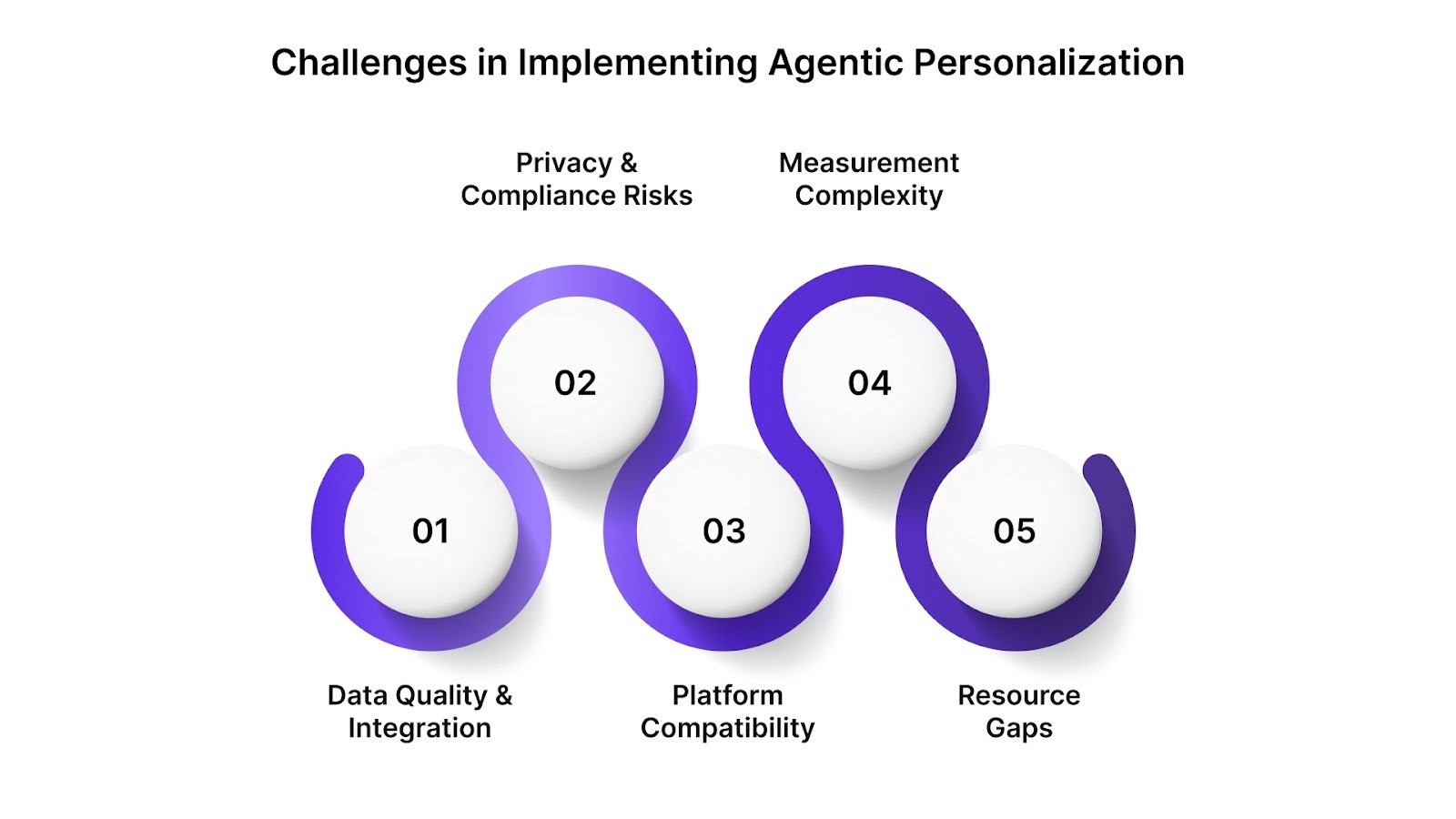
Adopting agentic personalization requires more than installing an AI tool; it demands alignment between data, technology, and marketing execution. While the rewards are significant, many e-commerce brands encounter practical barriers when integrating autonomous personalization systems at scale.
Common implementation challenges:
Data Quality and Integration: Fragmented or incomplete shopper data limits the accuracy of AI predictions and real-time decision-making.
Privacy and Compliance Risks: Handling behavioral data across multiple touchpoints must align with GDPR, CCPA, and changing consent frameworks.
Platform Compatibility: Legacy systems and rigid CMS platforms often struggle to support dynamic, modular experiences.
Measurement Complexity: Tracking ROI for constantly adapting layouts or offers requires advanced analytics and attribution models.
Resource Gaps: Many marketing teams lack the technical expertise or tools to launch and iterate AI-driven personalization effectively.
When brands face these obstacles, Nudge bridges the gap. It enables real-time personalization without dev dependency, assembles dynamic landing experiences, and continuously tests and optimizes layouts, all while maintaining compliance and speed.
Let’s see how Nudge helps overcome these challenges and enables brands to deliver personalized, AI-driven experiences more effectively in detail.
How Can Nudge Help You Deliver AI-Driven Personalized Experiences?
Nudge helps e-commerce brands create dynamic, adaptive shopper journeys, without relying on developers or complex integrations. Its AI-powered platform enables marketers to launch personalized, conversion-focused experiences across the entire funnel in real time.
What Nudge Offers:
Real-Time Personalization: Homepages, PDPs, PLPs, carts, and checkout pages adapt instantly to each shopper's behavior, location, and campaign source.
Commerce Surfaces: Build AI-powered landing pages that assemble dynamic product grids, personalized offers, and shoppable videos automatically.
AI Product Recommendations: Provide context-aware suggestions and smart bundles that align with shopper preferences and inventory levels.
Contextual Nudges: Trigger targeted banners, pop-ups, or modals based on exit intent, scroll behavior, or referrer to increase conversions.
Modular UI Elements: Dynamically optimize images, content blocks, layouts, and colors to test and iterate continuously, all without writing a single line of code.
Cart Recovery: Trigger personalized nudges and offers for abandoned carts to re-engage shoppers and recover lost revenue.
With Nudge, marketers gain complete control over personalization, achieving faster iterations, smarter experiences, and measurable business impact powered by AI.
Wrapping Up
Agentic personalization is changing how modern e-commerce brands engage with shoppers. By combining autonomous AI agents, real-time decision-making, and dynamic design, it transforms every customer session into a personalized, conversion-ready experience that drives measurable growth.
Nudge makes this level of personalization accessible to every marketer. With real-time personalization, modular UI elements, and AI-powered commerce surfaces, it empowers brands to deliver personalized journeys without relying on developers or complex tech stacks.
Book a demo today to see how Nudge can help your brand turn every shopper interaction into a smarter, more profitable experience.
FAQs
1. How is agentic personalization different from traditional AI personalization?
Traditional personalization relies on predefined rules and static data, while agentic personalization uses autonomous AI agents that make real-time decisions and adapt continuously based on user behavior and context.
2. Can agentic personalization work for smaller e-commerce brands with limited data?
Yes. Even with limited data, agentic systems can learn from live interactions, gradually improving personalization accuracy as customer engagement increases.
3. What metrics should you track to measure the success of agentic personalization?
Key metrics include conversion rate (CVR), average order value (AOV), customer lifetime value (LTV), and retention rate, each reflecting the direct impact of personalized experiences.
4. Does agentic personalization require customer profiles?
While traditional systems rely on fixed customer profiles, agentic personalization uses real-time data and behaviors to make dynamic decisions, reducing reliance on pre-built customer profiles.
5. How do I start implementing agentic personalization?
Start by selecting a platform like Nudge that offers AI-driven personalization tools. These tools allow marketers to create dynamic experiences without heavy technical setups, enabling real-time adjustments to improve customer journeys.
6. How does Nudge help brands deliver personalized e-commerce experiences?
Nudge enables marketers to create real-time, AI-powered landing experiences, dynamic product recommendations, and contextual nudges, helping brands drive higher conversions without developer dependency.