Comparisons
Nudge vs. Goodie AI: Comparing AI-Driven Search Platforms
Explore the key differences of Nudge vs. Goodie AI, how each platform drives AI search visibility & post-click personalization, boosts conversion rates, and improves user engagement.

Sakshi Gupta
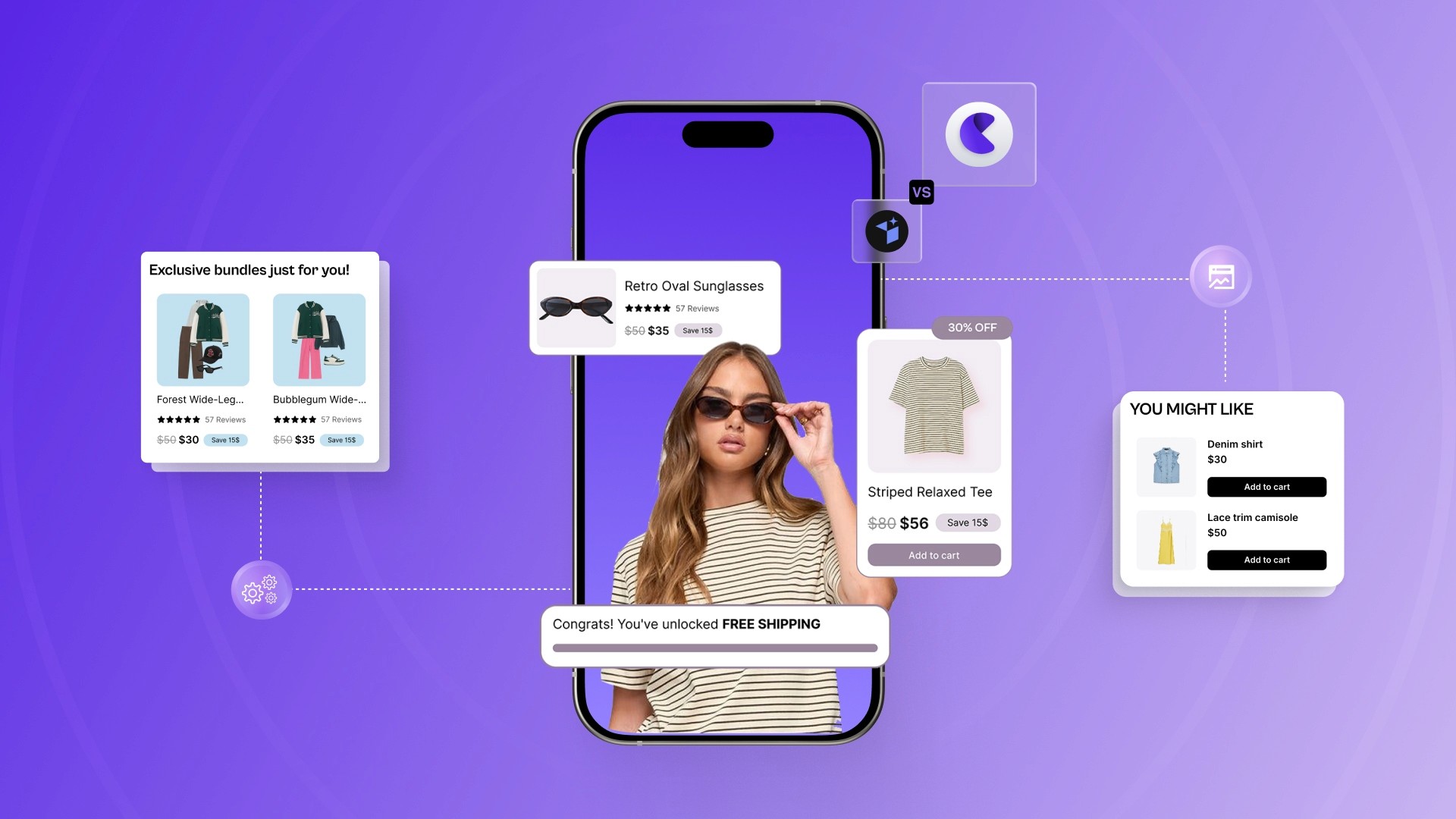




For e-commerce marketers, the pressure to keep up with ever-evolving shopper expectations is constant. As shopping moves to platforms like ChatGPT, Gemini, and Perplexity, commerce brands need to track their AI Search Visibility, rank in the prompts that matter to them, and convert that traffic.
Enter Nudge and Goodie AI, two AI visibility platforms. But which one truly helps e-commerce teams deliver dynamic, intent-based experiences without relying on developers?
In this blog, we’ll compare the strengths and features of both platforms, highlighting how they address key challenges like improving conversion rates, enhancing customer engagement, and streamlining marketing efforts.
Quick Recap
AI Search Visibility: Goodie AI tracks visibility across AI search platforms, while Nudge also integrates AI visibility with post-click personalization for a more dynamic experience.
Real-Time Personalization: Goodie AI does not offer real-time personalization, whereas Nudge personalizes landing pages and checkout flows based on real user prompts & queries.
Traffic & Attribution: Goodie AI focuses on visibility-based attribution, while Nudge tracks full-funnel attribution from ranking to traffic to purchase.
Integrations: Goodie AI offers limited integrations, while Nudge provides extensive integrations with e-commerce platforms like Shopify and marketing tools.
Scalability: Goodie AI is ideal for small businesses, while Nudge is built for high-growth e-commerce brands, scaling to large traffic volumes.
Nudge vs. Goodie AI: Core Positioning
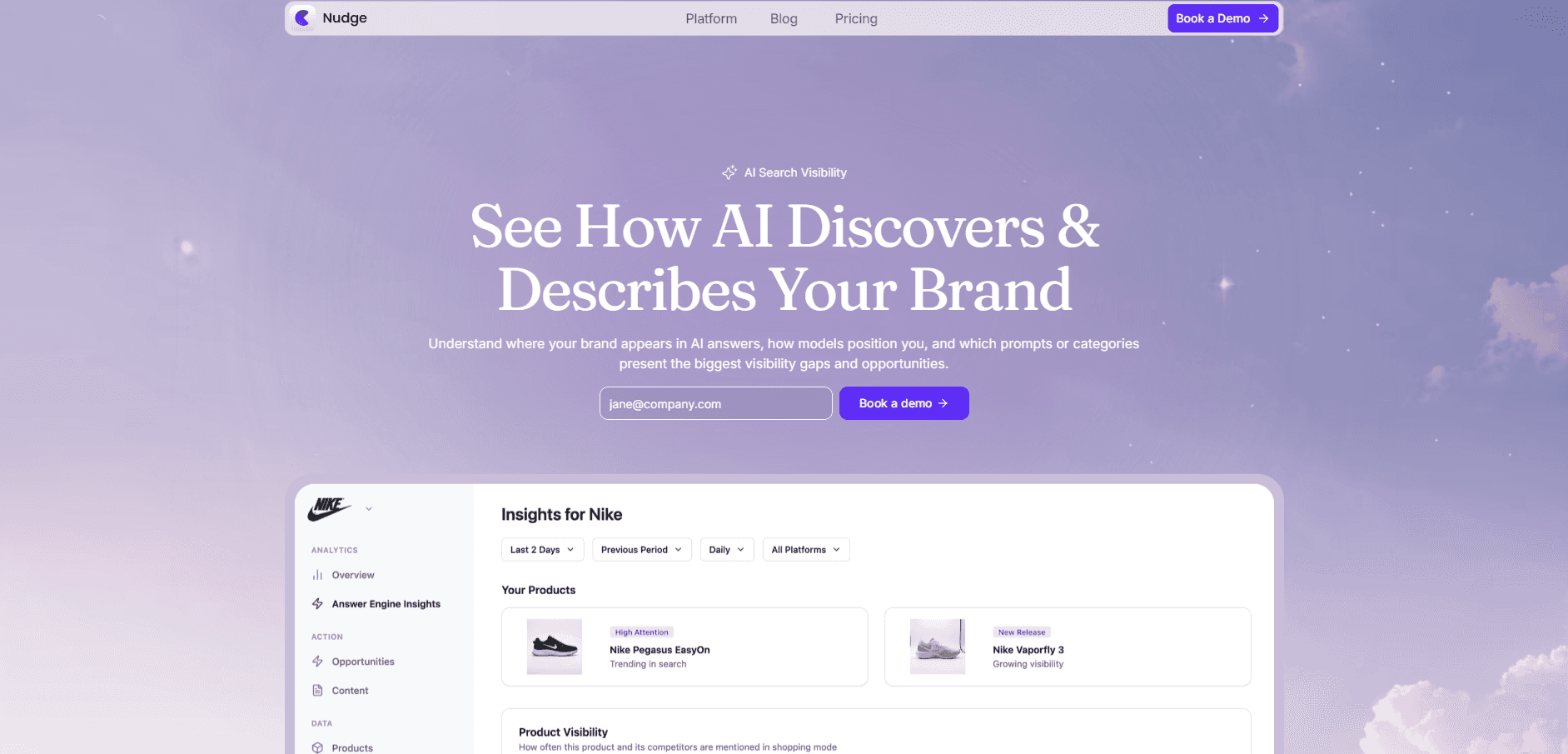
Nudge is a AI visibility and conversion platform for commerce brands. It helps your brand and products get recommended across AI engines (ChatGPT, Perplexity, Gemini), and automatically generates shoppable funnels optimized for real user prompts. Nudge allows marketing teams to personalize the entire shopping journey across key touchpoints, from homepages and landing pages to product detail pages and checkout.
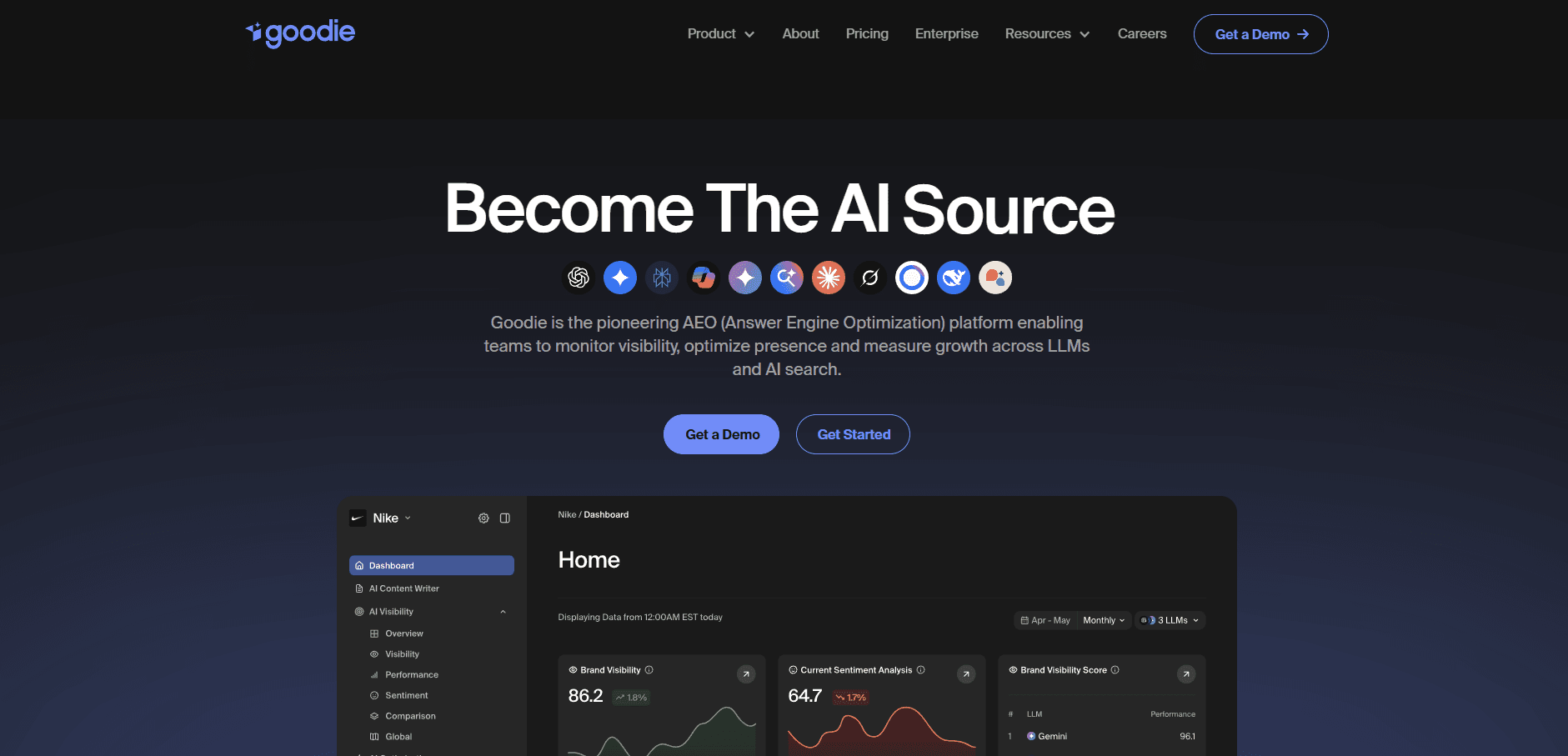
Goodie AI is an AI search visibility and optimization platform, primarily aimed at brands looking to enhance their presence within AI-driven search environments. Its focus is on improving how brands appear in AI-generated answers across platforms like ChatGPT and Gemini.
While Goodie AI focuses on optimizing visibility in AI search results, Nudge takes a broader, more impactful approach by enhancing the entire shopper journey. Nudge’s shoppable funnels drive higher engagement and conversions, addressing critical e-commerce challenges like post-click drop-off and customer retention.
Also Read: 8 Tips to Choose the Best AI Visibility Tools
Now that we've explored how Nudge and Goodie AI position themselves in the market, let’s take a closer look at the features each platform offers and how they stack up.
Nudge vs. Goodie AI: Key Feature Comparison
Both Nudge and Goodie AI offer distinct solutions for improving e-commerce AI Search visibility, but they target different aspects of the shopping experience.
Goodie AI is primarily focused on optimizing visibility in AI search results, whereas Nudge integrates AI search visibility with post-click shopper personalization, turning prompts into shoppable landing experiences that drive engagement and conversions at every touchpoint in the e-commerce funnel.
Quick Glance: Nudge vs. Goodie AI: Comparison table
Feature | Goodie AI | Nudge |
AI Search Visibility | Tracks brand presence across AI platforms (ChatGPT, Gemini, etc.). | Tracks brand presence and integrates real-time shopper personalization, optimizing content for visibility and citation. |
Content Optimization | AI Content Writer, Topic Explorer for visibility and content optimization. | Content optimization of landing pages, PDPs, and checkout flows based on shopper prompts & queries. |
Traffic Attribution | Measures traffic and attribution for AI-generated mentions. | Full-funnel attribution tracking shopper behavior and conversions. |
Shoppable Funnels | Does not have shoppable funnels. | Shoppable funnels based on the exact prompt that drove the visit, helping shoppers move confidently from answer to checkout. |
Integrations | Limited integrations with AI platforms. | Extensive integrations with e-commerce platforms and marketing tools. |
Scalability | Best for small to medium-sized businesses. | Built for high-growth e-commerce brands, scales to large traffic volumes. |
1. AI Visibility and Content Optimization
Goodie AI
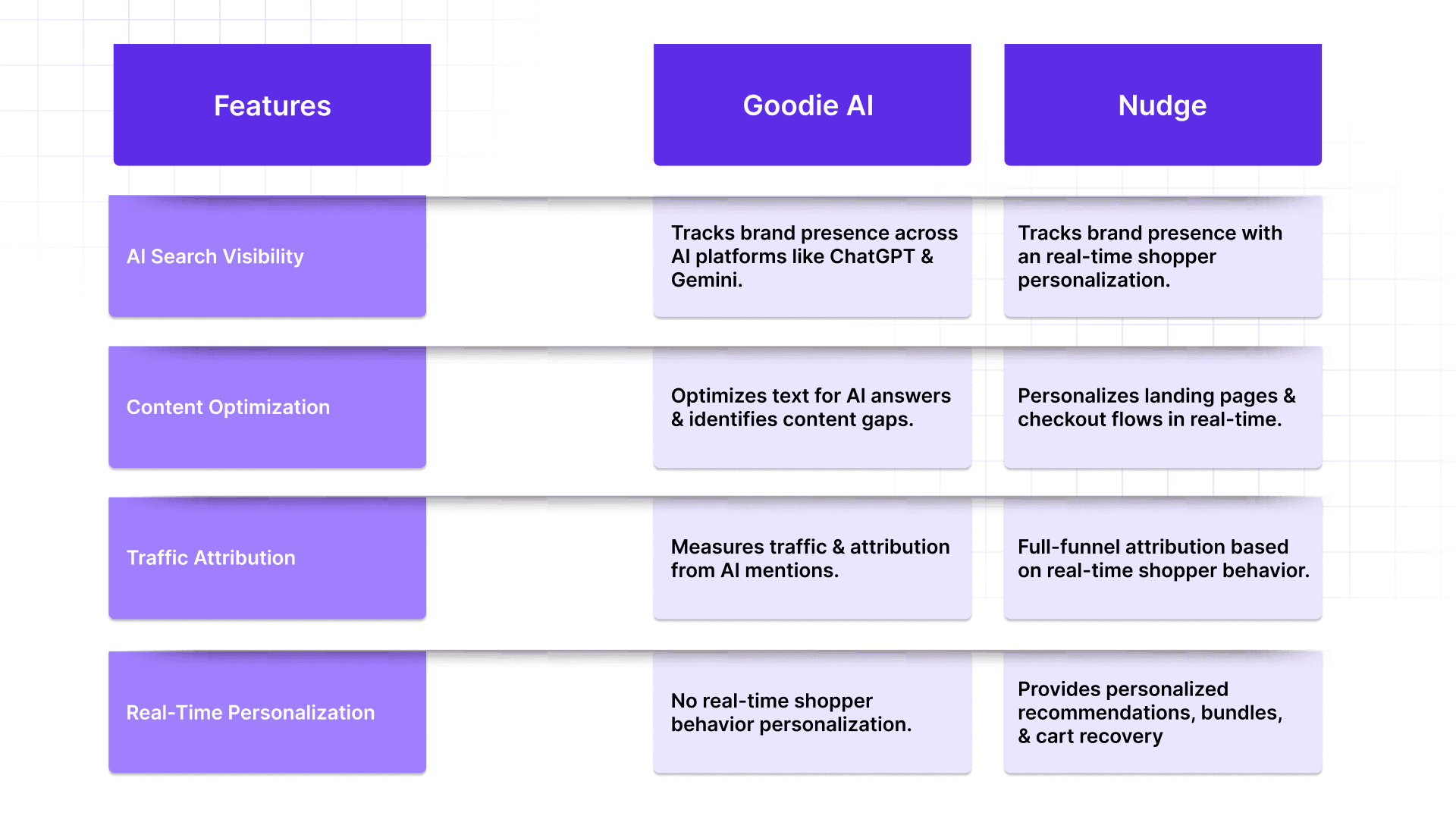
AI Search Visibility: Tracks brand presence across ChatGPT, Gemini, Perplexity, and other AI platforms.
Content Optimization: AI Content Writer helps create optimized text for AI answers; Topic Explorer surfaces content gaps.
Traffic Attribution: Measures traffic and attribution for AI-generated mentions, showing downstream effects.
Real-Time Personalization: Does not offer real-time personalization based on shopper behavior.
Nudge
AI Search Visibility: Tracks brand presence across similar AI platforms (ChatGPT, Gemini, Perplexity) but integrates real-time shopper personalization with AI search visibility.
Content Optimization: Personalizes landing pages, PDPs, and checkout flows in real-time based on shopper prompts & chat queries.
Traffic Attribution: Full-funnel attribution based on real-time shopper behavior, tracking conversions from landing page to checkout.
Real-Time Personalization: Shoppable funnels based on the exact prompt that drove the visit, helping shoppers move confidently from answer to checkout.
Also Read: 11 Best Strategies for Ecommerce Search Personalization
2. Integrations and Scalability
Goodie AI
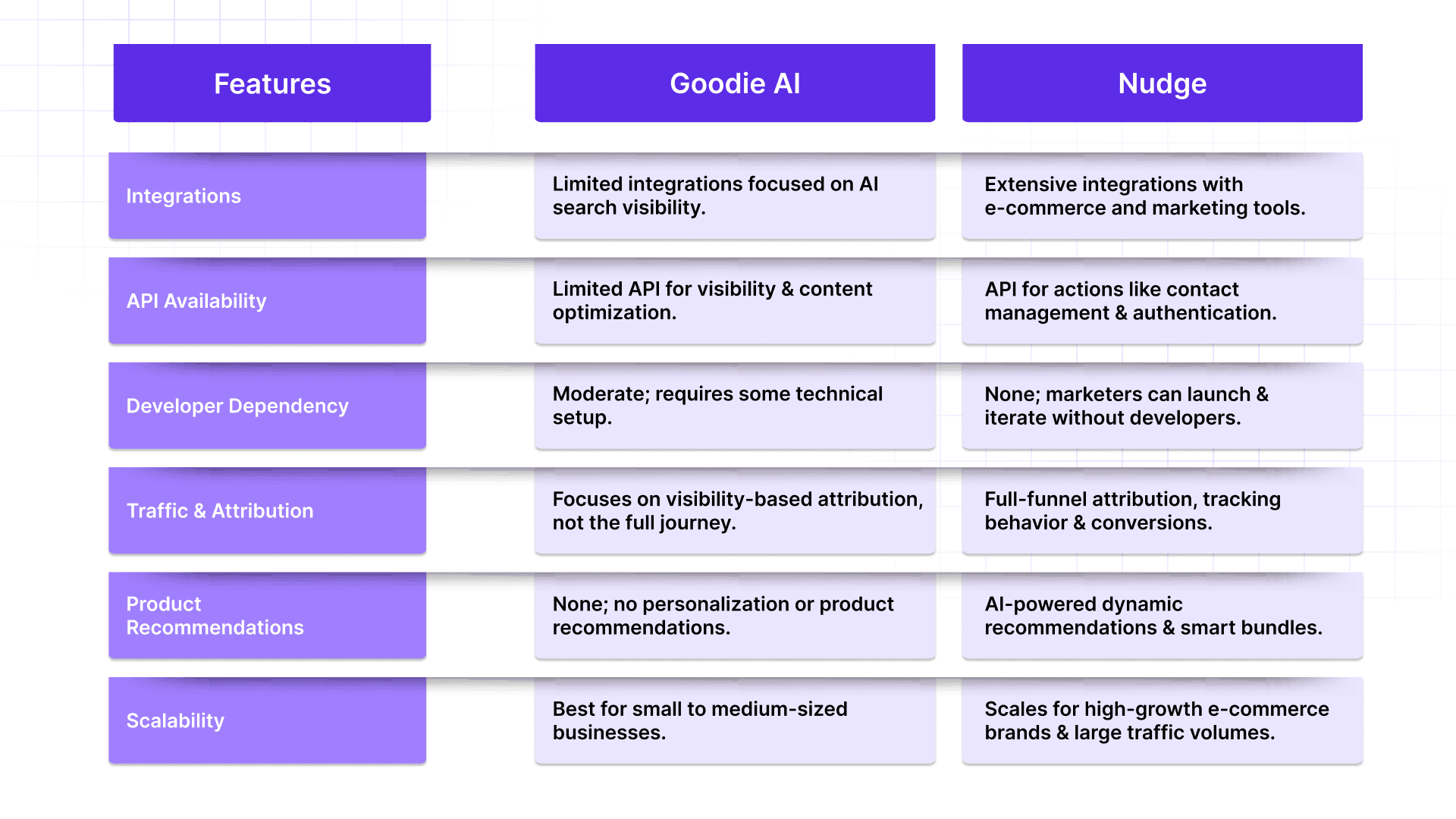
Integrations: Limited integrations, primarily for AI search visibility.
API Availability: Limited API functionality, focused on visibility and content optimization.
Developer Dependency: Moderate; requires some technical setup for SEO-focused teams.
Traffic & Attribution: Focuses on visibility-based attribution; does not track full customer journey.
Product Recommendations: None; no personalization or product recommendations.
Scalability: Best for small to medium-sized businesses looking to optimize AI search visibility.
Nudge
Integrations: Extensive integrations with e-commerce platforms, marketing tools, and analytics software for seamless personalization and data sharing.
API Availability: API access for key actions like contact management and authentication.
Developer Dependency: None; marketers can launch and iterate without relying on developers.
Traffic & Attribution: Full-funnel attribution; tracks shopper behavior and conversions from landing page to checkout.
Product Recommendations: AI-powered dynamic product recommendations and smart bundles based on shopper behavior and inventory.
Scalability: Built for high-growth e-commerce brands and can scale to handle large volumes of traffic and real-time personalization.
3. Speed and Agility
Goodie AI
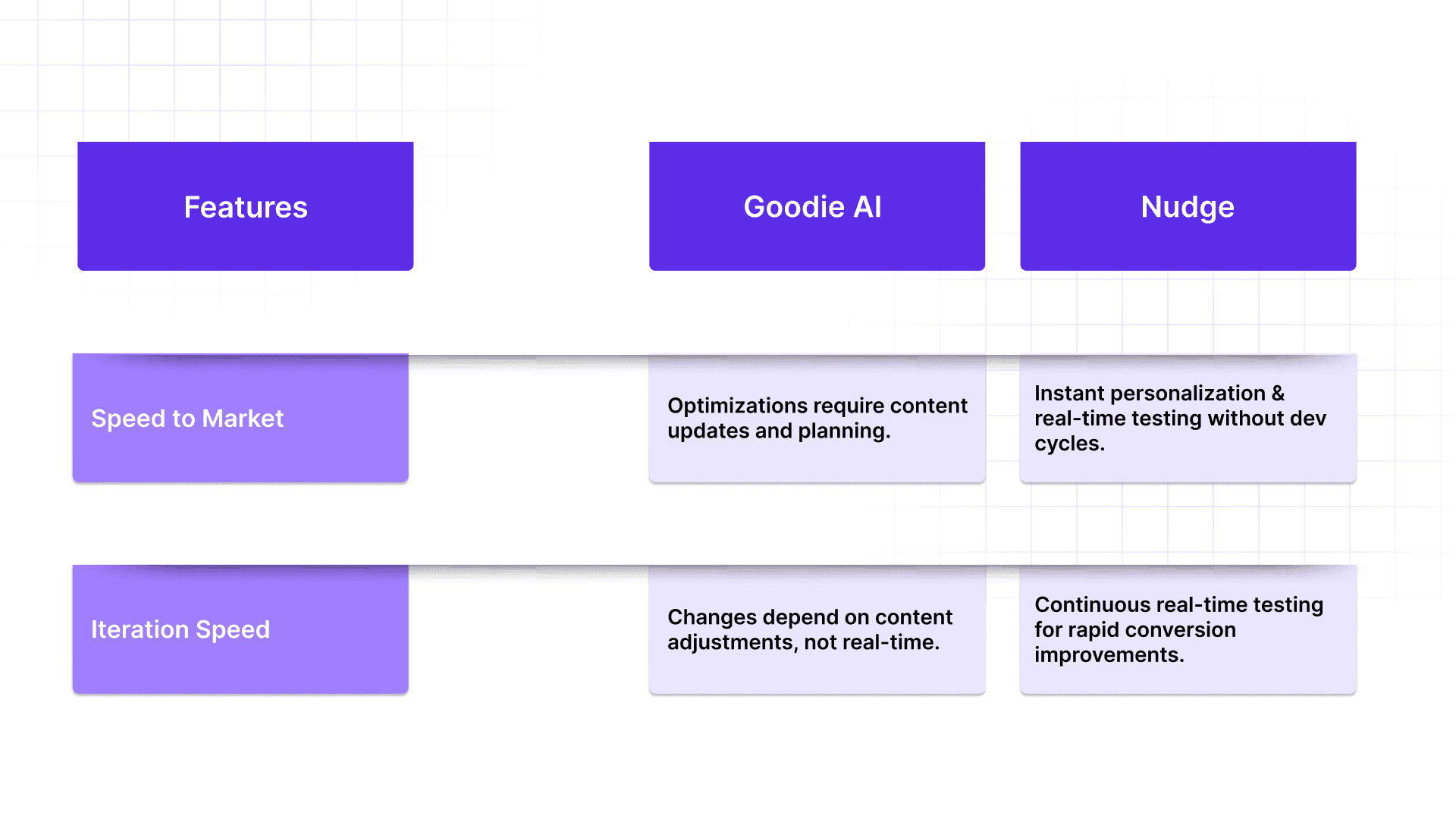
Speed to Market: Optimizations tied to content updates and AI search visibility, requiring planning and content creation efforts.
Iteration Speed: Changes depend on content adjustments and visibility optimization, which are not real-time.
Nudge
Speed to Market: Instant personalization and real-time testing without needing dev cycles, enabling faster optimization.
Iteration Speed: Continuous real-time testing of layouts, content, and recommendations, driving rapid conversion improvements.

4. Pricing Comparison: Value for Money
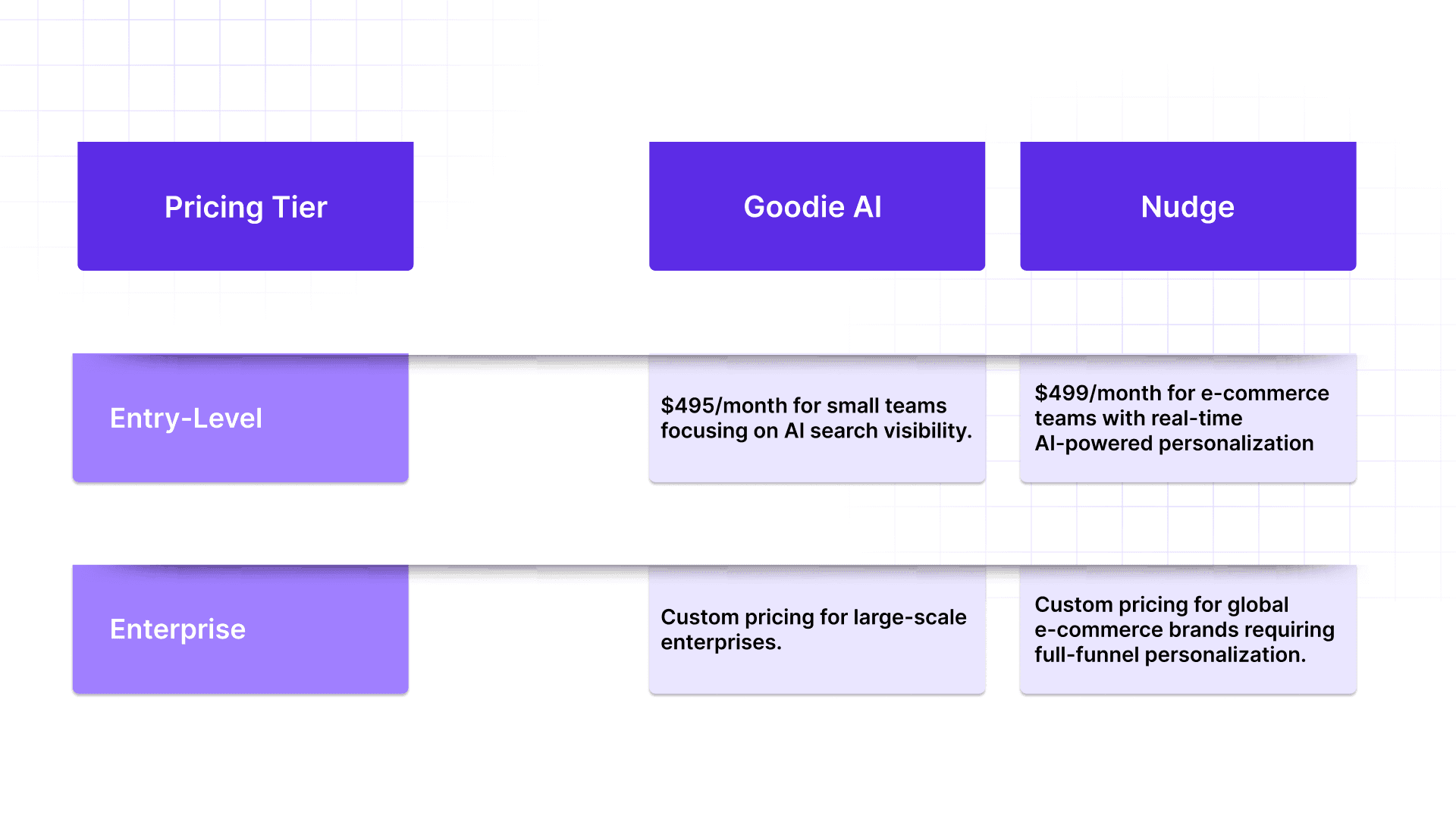
Pricing Tier | Goodie AI | Nudge |
Entry-Level | $495/month for small teams focusing on AI search visibility. | $499/month for e-commerce teams with AI visibility & post-click conversion. |
Enterprise | Custom pricing for large-scale enterprises. | Custom pricing for global e-commerce brands requiring full-funnel personalization. |
At similar pricing points, Nudge offers more value for e-commerce brands looking to optimize the entire shopper journey, not just search visibility. Nudge’s real-time personalization and full-funnel engagement capabilities offer more comprehensive solutions than Goodie AI’s focus on AI search performance.
With a clearer understanding of their features, let’s examine which platform truly meets the needs of e-commerce brands and drives long-term success.
Nudge vs. Goodie AI: Which Platform Is Truly Built for E-Commerce Success?
Nudge vs. Goodie AI: Which Platform Is Truly Built for E-Commerce Success?
When it comes to boosting e-commerce performance, choosing Nudge vs. Goodie AI boils down to whether you prioritize AI search visibility or a fully personalized shopper journey that drives conversions.
Goodie AI: Strengths
AI Search Visibility: Goodie AI shines in helping brands track and improve their visibility across major AI platforms like ChatGPT and Gemini, essential for improving presence in AI-driven search results.
Content Optimization for AI: The platform enables brands to optimize their content, improving how they rank in AI-generated responses, thus boosting brand recognition.
AI Attribution Analytics: Provides insightful analytics on AI-driven sessions and conversions, helping brands fine-tune their strategies.
Multi-Model Visibility Scoring: Tracks visibility across various AI models, providing businesses with a comprehensive view of their performance.
Nudge: Strengths
Turn AI visibility into conversion: Goodie AI ends at the AI answer. Nudge goes further. We generate prompt-specific landing pages and funnels aligned to the exact question that drove the click, so shoppers land on content built to evaluate, compare, and buy.
Track brand + product prompts: Most AI visibility tools like Profound stop at brand-level mentions. Nudge tracks both brand and SKU-level prompts, so commerce teams can see exactly which products get recommended, which don’t, and why.
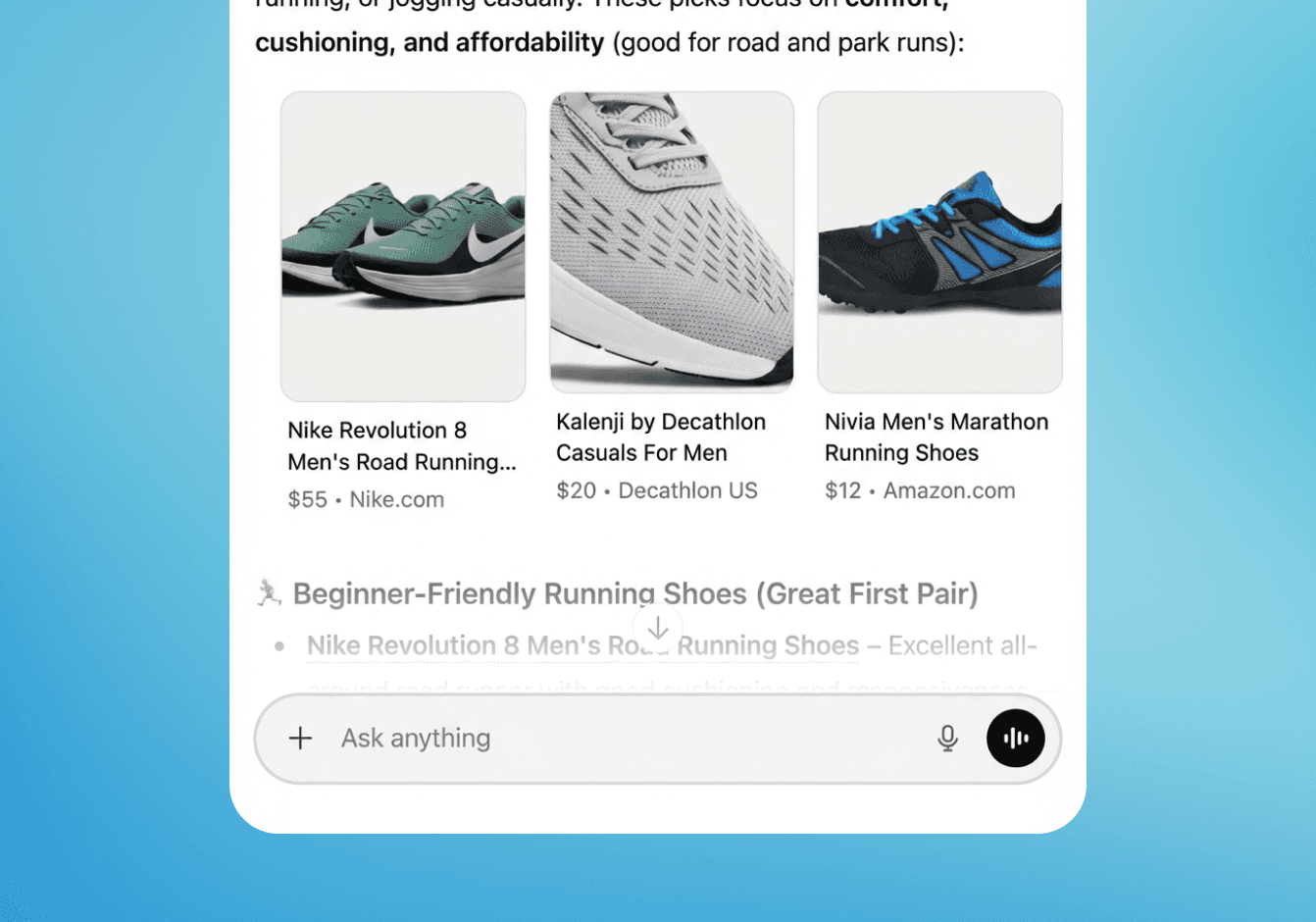
Embed the product on the page: Goodie AI only lets you write blogs & listicles. Nudge lets you embed the right products & proof points on the pages you’re creating, to help shoppers checkout directly from the landing page and reduce any friction to purchase.
Full-Funnel Engagement: Unlike Goodie AI, Nudge covers the entire e-commerce funnel, from AI Search Visibility to post-click conversion.
Compounding Advantage for E-Commerce Growth: Nudge scales with high-growth e-commerce brands, speeding up market launches, personalization, and driving higher conversion rates and customer lifetime value (LTV).
Where Goodie AI Falls Short
Limited to AI Search Visibility: Goodie AI focuses on search optimization but doesn’t influence the post-click shopper journey, missing opportunities for deeper engagement and conversions.
No Real-Time Personalization: It tracks visibility but lacks real-time personalization based on shopper behavior, limiting the ability to tailor the experience once they land on a site.
Lack of Full E-Commerce Solutions: Goodie AI doesn’t address key e-commerce needs like conversion optimization or cart abandonment recovery, focusing primarily on visibility.
Limited Enterprise Support: Lacks critical enterprise-grade features and certifications (e.g., SOC 2, HIPAA), which can be a dealbreaker for larger businesses with strict compliance needs.
Why Nudge Is the Superior Choice Over Goodie AI
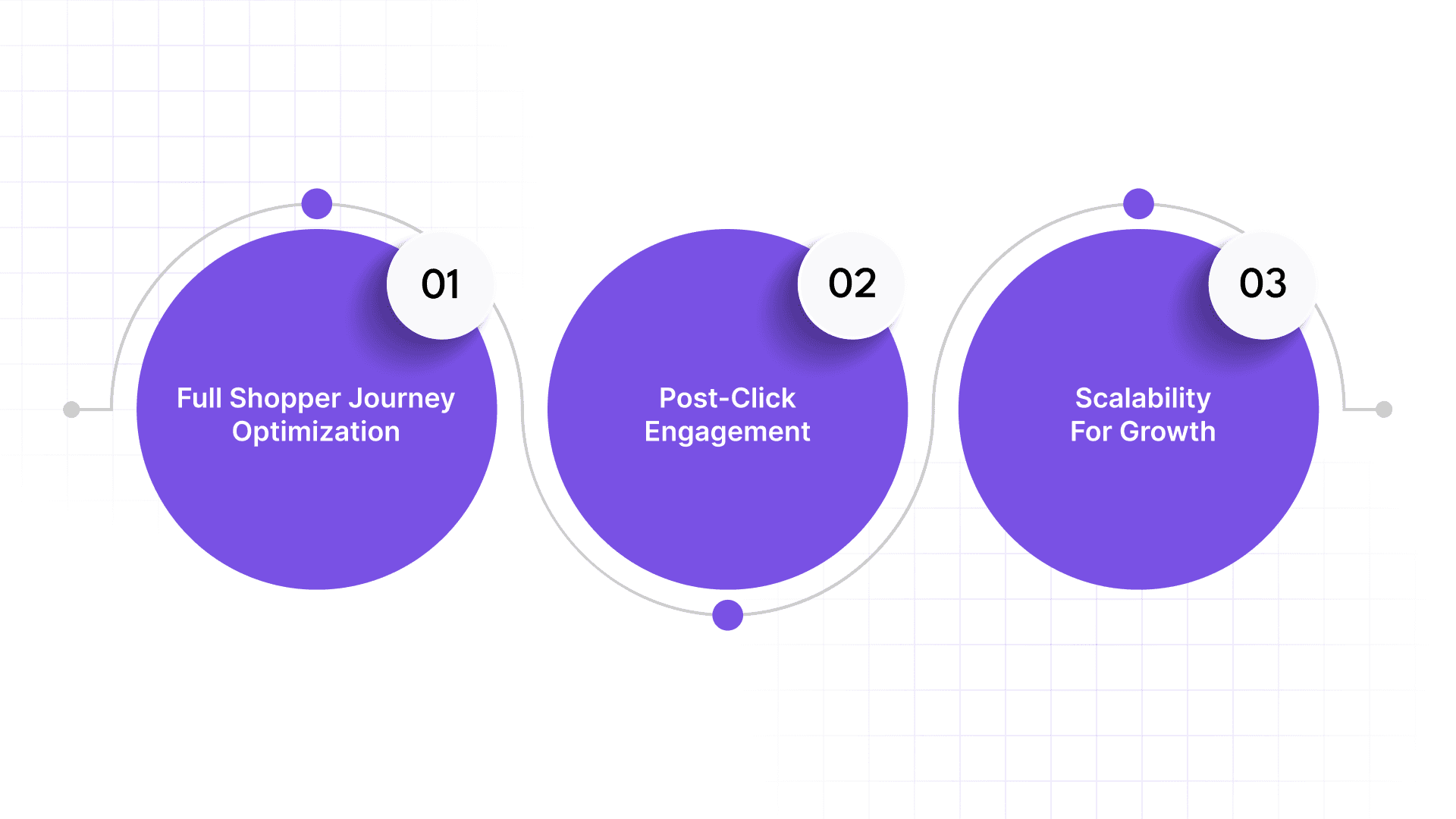
Full Shopper Journey Optimization: Nudge combines AI search visibility with real-time personalization, enhancing both visibility and engagement across the entire e-commerce funnel, unlike Goodie AI, which focuses only on search visibility.
Post-Click Engagement: Nudge drives visibility and increases conversions with smart recommendations, bundles, and post-click shoppable funnels. Goodie AI doesn’t address post-click activity.
Scalability for Growth: Nudge scales to handle high volumes of traffic and real-time personalization. Goodie AI is more suited for smaller brands focused on AI search optimization.
While Goodie AI strengthens AI search visibility, Nudge turns that visibility into real-time, full-funnel revenue impact through personalization, conversion optimization, and scale.
For e-commerce brands looking to convert, engage, and scale, Nudge is the clear superior choice. Ready to enhance your e-commerce experience? Book a demo with Nudge today and see how our AI-powered platform can help your brand grow smarter and faster.
Next Read: 20 Best Practices For E-commerce Landing Page Optimization
FAQs
1. What is the primary difference between Goodie AI and Nudge?
Goodie AI focuses on AI search visibility and optimizing content for better ranking within AI-driven search platforms. In contrast, Nudge combines AI search visibility with real-time shopper personalization to drive conversions and enhance the entire customer journey across e-commerce platforms.
2. Does Nudge offer AI search visibility like Goodie AI?
Yes, Nudge tracks AI search visibility across platforms like ChatGPT, Gemini, and Perplexity. However, unlike Goodie AI, Nudge integrates this visibility with shoppable funnels, providing a more comprehensive approach to e-commerce growth.
3. How does Nudge's real-time personalization help e-commerce brands?
Nudge personalizes each shopper's journey by dynamically adjusting landing pages, product details, and checkout flows based on real user prompts & chat queries. This boosts engagement, improves conversions, and enhances the overall shopping experience.
4. What kind of integrations does Nudge offer?
Nudge provides extensive integrations with e-commerce platforms, marketing tools, and analytics software like Shopify, Meta, and Google Ads, allowing for a seamless personalization and optimization experience.
5. How does Nudge handle full-funnel attribution?
Nudge offers full-funnel attribution, tracking AI brand & product mentions on various AI engines, traffic on landing pages all the way through checkout, providing actionable insights to improve conversions and maximize return on investment (ROI).